



September 2, 2026 The Phone System Is a Computer Too: An Actively Exploited Switchvox Flaw and What Your Practice Must Patch
On the last day of August, security researchers confirmed that attackers are actively exploiting CVE-2026-9586 – a critical flaw, rated 9.3 out of 10, in Sangoma Switchvox, an enterprise VoIP platform used to run office phone systems. The uncomfortable detail is how little the attacker needs: no password, no user account, no malware. An unauthenticated request to the right endpoint lets a stranger on the internet run code on the box as the database superuser. If your practice runs a Switchvox phone system, the thing humming in your wiring closet is currently a target – and the reason it is a target is a lesson that applies to far more than one product.
What the researchers found
The flaw was disclosed by Horizon3, which had been auditing Sangoma’s products after related FreePBX vulnerabilities landed on the U.S. government’s known-exploited-vulnerabilities list. In total the team reported twelve distinct vulnerabilities in Switchvox; this one is the most severe. The mechanism is a textbook failure. Switchvox exposes an unauthenticated HTTP endpoint that parses an XML message sent by supported IP phones. One field inside that message – the phone’s IP – is concatenated directly into a database query that was never written to expect hostile input. That is a classic SQL injection: an attacker puts database commands where a value should go, and the server dutifully runs them. Because the query runs with database superuser rights, the injection does not stop at reading records – it reaches all the way to command execution and a reverse shell, handing the attacker an interactive foothold on the appliance.
This is not theoretical. Honeypots have already captured real attack traffic, the flaw class was first disclosed by independent researchers in July 2026, and a public scan shows roughly 4,000 internet-exposed Switchvox instances, most of them in North America. The good news is that there is a fix: Sangoma has patched the flaw in version 8.4.0.2. Everything below that on an internet-reachable box should be treated as exposed until proven otherwise.

A phone system is a full computer – that is the real story
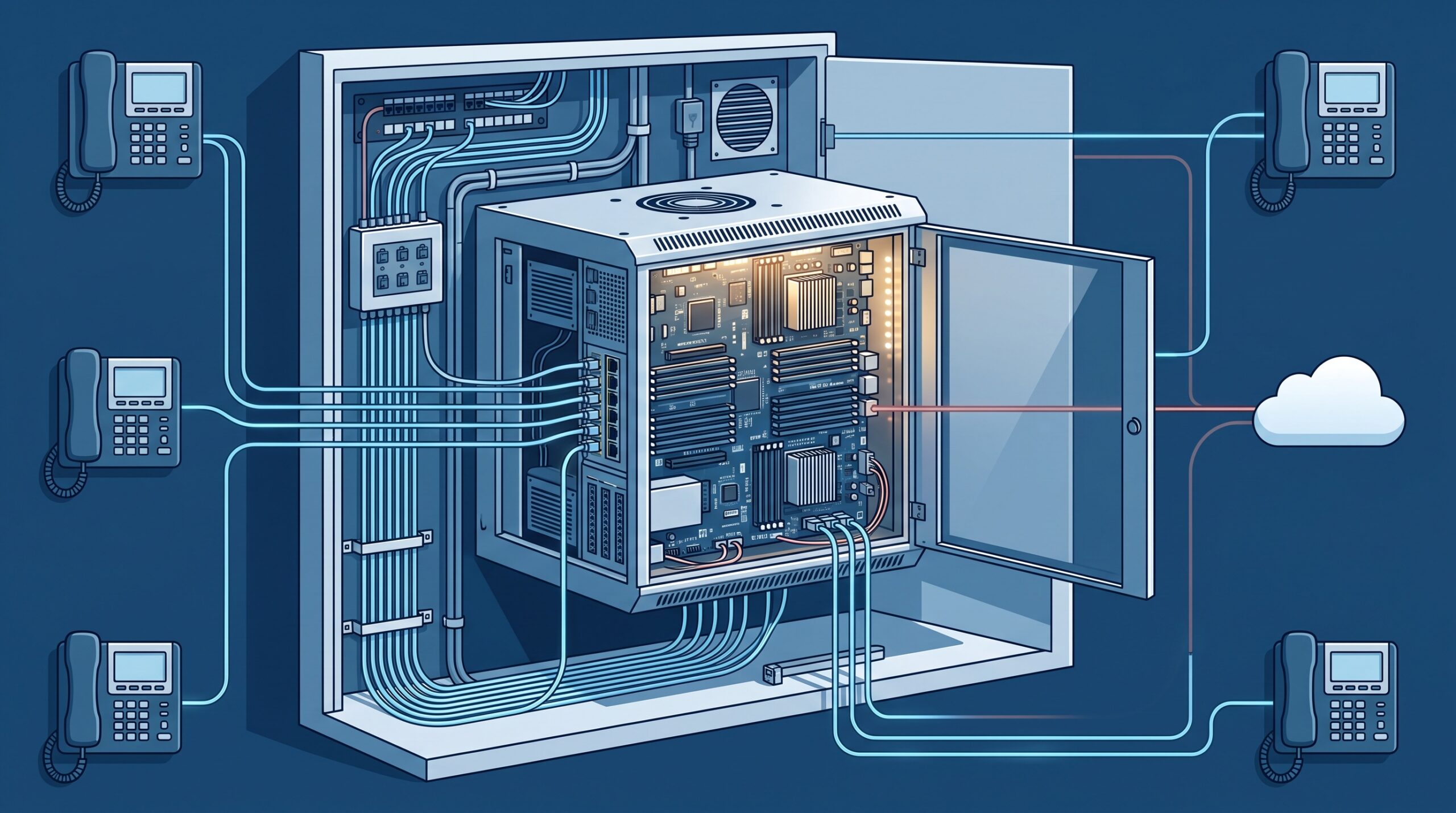
It is tempting to file this under “telephone problem” and move on. Don’t. A modern VoIP PBX like Switchvox is not an appliance in any meaningful sense – it is a Linux server running a database, sitting on your practice network, often with a web interface reachable from the outside so the vendor or a remote admin can manage it. In other words, it is exactly the same kind of computer as the server your practice-management software runs on, and it is exposed to exactly the same kinds of attacks. The only difference is that nobody thinks of it that way, so nobody patches it, and nobody notices it going quietly out of date in a closet for years.
We keep running into the same shape of problem from different directions. It was true of the print server no one calls IT about, and it was true of the single vendor quietly running a practice’s network, cameras, and phones. The phone system is simply the next forgotten computer on the list. Every one of these boxes is a small server with a network cable, and every one of them needs the same discipline you would apply to a workstation.
What a hijacked phone system actually hands an attacker
Assume the worst has happened and someone owns your PBX. What do they get? Three things worth taking seriously. First, toll fraud – the oldest and most immediate motive – where an intruder uses your telephony to place expensive international or premium-rate calls and leaves you the bill. Second, and more sensitive for a dental office, the calls themselves: a compromised PBX can intercept or record conversations and voicemails, which in a practice routinely contain patient names, appointment details, medication questions, and other protected health information that never belonged in an attacker’s hands.
The third consequence is the one that should worry you most. A phone system that shares a flat network with everything else becomes a quiet foothold. From that box an attacker can look sideways at the practice-management server, the imaging workstations, and the Microsoft 365 credentials cached around the office, and begin to pivot toward the data that actually matters. It is also a ready-made platform for the kind of layered attack we keep urging practices to plan for: control of your telephony makes fraudulent calls to your patients – or to your own staff – far more convincing. The initial break-in is a phone flaw; the damage is a whole-network problem.

Is your practice exposed?
Three questions decide it. Do you run Sangoma Switchvox SMB Edition? Is its management or phone-provisioning interface reachable from the public internet? And is it running a version below 8.4.0.2? If the answer to the first is yes and you are not certain about the other two, treat the box as exposed and act today. The honest complication is that many practices cannot answer the first question – the phone system was installed years ago by a telecom vendor, it has worked ever since, and no one in the office knows the brand, the version, or who is responsible for updating it. That uncertainty is itself the vulnerability. An asset nobody owns is an asset nobody patches.

What to do now
None of the remediation here is exotic; it is the same fundamentals that protect any networked computer, finally applied to the one in the phone closet.
- Update to Switchvox 8.4.0.2 immediately. If you run Switchvox, this is the single most important step, and it is being exploited right now – it is not a next-quarter item. If a vendor manages your phones, call them today and get written confirmation of the version.
- Get the management interface off the public internet. A PBX admin or provisioning page should not be reachable from the open web. Put it behind the firewall and require a VPN for remote management. This one change defuses the entire class of internet-facing attack, not just this CVE.
- Inventory every networked appliance. Phone system, print server, network switches, cameras, door controllers, imaging hardware – list each one, its version, and who is responsible for patching it. You cannot secure a device you have forgotten you own.
- Segment the phone system away from clinical systems. The PBX does not need to share a network with your practice-management server and imaging workstations. Putting voice traffic on its own segment means a compromised phone system is a contained problem, not a doorway into patient data.
- Assign ownership of telephony patching. Decide – in writing – whether your telecom vendor or your IT provider is responsible for keeping the phone system current, and hold that answer to the same standard as your server patching. Silence is how a box stays years out of date.
The Switchvox flaw will be patched and forgotten within a month. The pattern behind it will not go away: the modern dental office is full of small computers wearing the costume of appliances, and attackers have learned to go after the ones nobody is watching. The phone system was never just a phone system.
If you are not certain what brand of phone system your practice runs, whether its management interface is exposed to the internet, or who is responsible for keeping it patched, contact Compudent Systems. We help dental practices across Ontario inventory every networked device – phones included – get management interfaces off the public internet, segment voice traffic away from clinical systems, and put clear ownership behind the patching that keeps a forgotten box in a closet from becoming the way in.
Sources & further reading:
- CVE-2026-9586: Sangoma Switchvox RCE – Horizon3 attack research disclosure
- CVE-2026-9586: Switchvox RCE Exploited in the Wild – SecurityOnline
Related Reading
- One Vendor Runs Your Network, Cameras, and Phones: Three Max-Severity Ubiquiti Flaws and What Your Practice Must Patch
- Ransomware Gangs Are Now Through the Front Door: What the SonicWall SMA1000 VPN Attacks Mean for Dental Practices
- A Fake Job Offer, a Windows Kernel Rootkit: The Lazarus Zero-Day (CVE-2026-68820) and What It Means for Your Dental Practice