




October 12, 2026 The ADA Now Says Scan Less — So Your Records Have to Say Why: What the 2026 Imaging Guidelines Mean for Your Practice Software
For most of the last decade, the question of when to take a dental radiograph had a comfortable, semi-automatic answer: bitewings at recall, a panoramic every few years, a full series for new patients. In early 2026 the American Dental Association, together with the American Academy of Oral and Maxillofacial Radiology, replaced that reflex with something more demanding. In the first major revision of dental imaging guidance since 2012, the message is blunt: image only when clinically necessary, choose the smallest exposure that answers the clinical question, and base the decision on the individual patient in front of you — history, prior films, and risk — rather than the calendar.
Clinically, that is sound radiation-safety practice and few will argue with it. But there is a quieter consequence that lands squarely in the lap of whoever runs your practice’s technology and recordkeeping: if an image must now be justified by a documented clinical reason, then your software, your charting habits, and your retention policy have to be able to prove that reason existed. “We always do bitewings at recall” is no longer a defensible record. This is as much an IT and compliance change as a clinical one.
What actually changed in the 2026 guidance
The headline is a shift from routine, schedule-driven imaging to individualized, needs-based imaging. The guidance brings two-dimensional radiographs and three-dimensional cone-beam CT under one selection-criteria framework and leans hard on the long-standing ALARA principle — keeping exposure As Low As Reasonably Achievable. Practically, it asks clinicians to review the patient’s history and any existing images first, order imaging only when it will change diagnosis or treatment, and when CBCT is indicated, use the smallest field of view that captures the needed information.
It arrives alongside other moving parts practices are already absorbing, including earlier ADA guidance that routine thyroid and abdominal shielding be discontinued, and a patchwork of state-level rule changes catching up to it — Nevada, for example, moved to align its requirements with ADA guidance as of mid-2026. The result is that “what we have always done” is now out of step with both the national guidance and, increasingly, the rules your own regulator enforces.
Why this is a documentation problem, not just a clinical one
Think about what the new standard implies for the record. If imaging is only appropriate “when clinically necessary,” then the absence of a documented reason is no longer neutral — it is a gap. In an audit, a College inquiry, a malpractice claim, or an insurance review, the question is not just “was the X-ray appropriate?” but “where is the contemporaneous note showing the clinical indication?” A practice that images correctly but documents poorly can still be the one that cannot defend itself.
That exposure is not hypothetical. Dental practices are already under real regulatory and financial scrutiny over how they handle patient records — we have written about a week in which one practice absorbed a six-figure regulatory penalty tied to its recordkeeping and security failures. The new imaging guidance adds one more place where the record has to hold up, and in Ontario it intersects directly with your PHIPA obligations around complete, accurate, and retained health records.
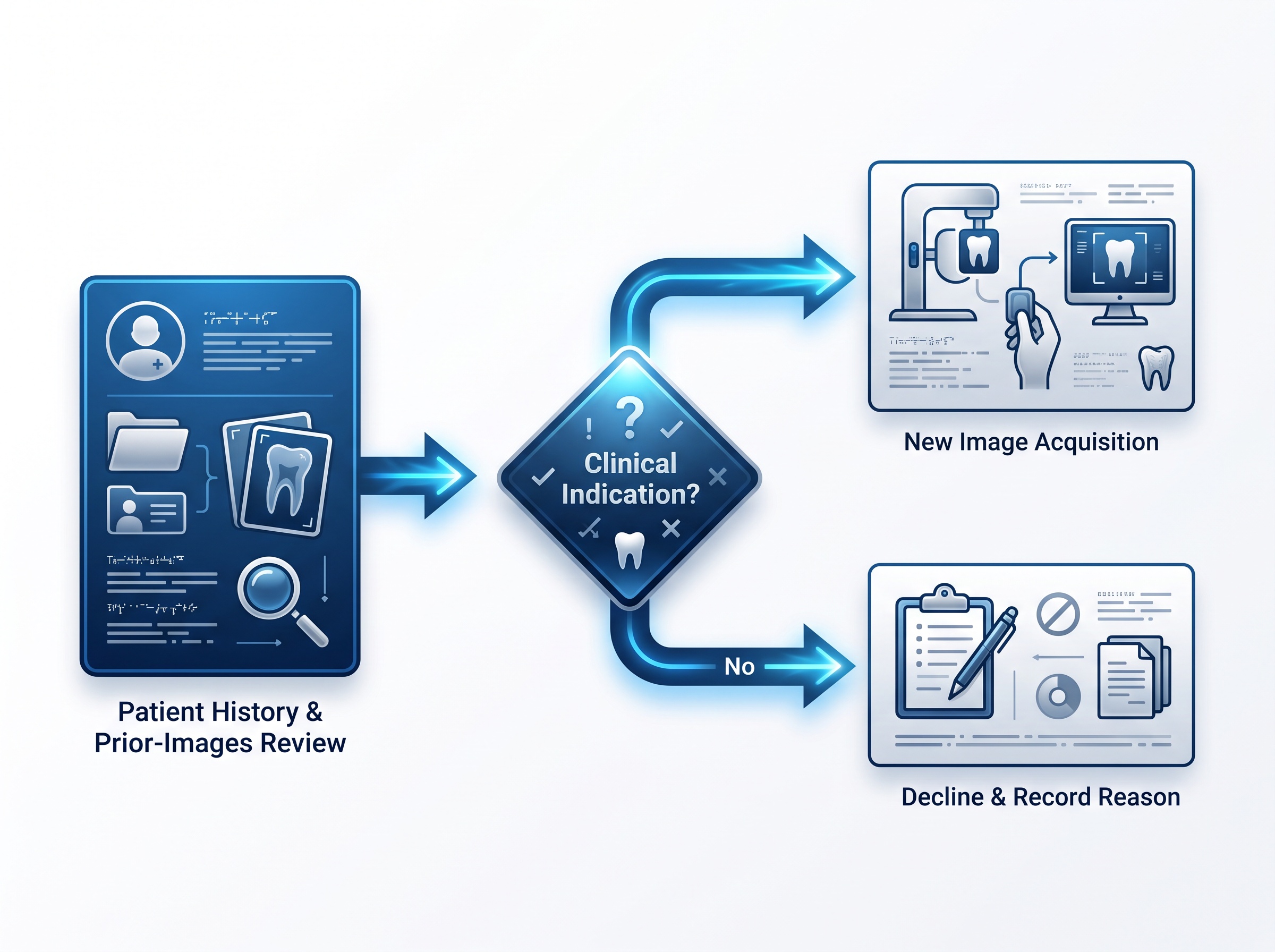
Build the justification into the software, not the memory
The fix that fails is “everyone, please remember to write why you took the X-ray.” Under pressure, in a busy operatory, free-text good intentions evaporate. The fix that works is structural: capture the clinical justification as a defined field or template inside the practice management system, attached to the imaging event itself, so the record is created as a by-product of normal workflow rather than an extra chore.
Most modern practice management platforms can be configured with custom clinical note templates, required fields, or quick-pick justification codes tied to an imaging order. The goal is that when a radiograph is captured, the chart automatically prompts for and stores the indication — new symptom, specific diagnostic question, treatment planning, trauma, caries risk — alongside the date, the operator, and a link to the image. Done well, compliance stops depending on individual discipline and becomes the path of least resistance.

Retention and retrieval become clinical tools
The guidance’s instruction to review prior images before exposing a patient quietly raises the stakes on something practices often treat as mere storage. You cannot avoid a redundant radiograph if the earlier one is unfindable, stranded in a retired system, or lost to a failed drive. Retention and fast retrieval of historical images are now part of delivering care to the standard, not just a bookkeeping nicety.
This is where imaging infrastructure earns its keep. Your images have to be retained for the full period your regulator requires, retrievable in seconds at chairside, and portable enough that a change of software does not orphan a decade of history — a fragility we explored in our piece on why imaging breaks when you switch practice management systems. It also has to survive the bad day. A verified, immutable and air-gapped backup of your imaging database is what turns “review the prior image” from an aspiration into something you can actually do after a ransomware hit or a server failure.
A practical checklist for your practice
You do not need to overhaul everything at once. A focused pass across process, software, and policy closes most of the gap:
- Add an imaging-justification step to your charting template. Make the clinical indication a structured, prompted field on every imaging event, not an optional free-text note.
- Write a one-page imaging policy that cites the 2026 selection-criteria approach. It signals to staff, patients, and any future auditor that your protocol is deliberate and current, not habitual.
- Confirm prior images are easy to pull up before exposure. If retrieving last year’s bitewings takes more than a few clicks, your workflow is quietly pushing people toward re-imaging.
- Verify retention settings and backups against your regulator’s required period. Know where images live, how long they are kept, and that a restore actually works.
- Check your current state and provincial rules. National guidance and local requirements are converging but not identical — confirm yours, especially around shielding and CBCT.

The takeaway
The 2026 imaging guidance is good medicine: less unnecessary radiation, more deliberate decisions, better care. But “image only when necessary” carries an implicit second half — and be able to show why. The practices that come through this change cleanly will not be the ones that simply image less; they will be the ones whose software, charting templates, and retention policies turn every imaging decision into a defensible record automatically. That is a configuration and process project, and it is one worth doing before, not after, someone asks you to justify a radiograph you took two years ago.

How Compudent Systems can help
At Compudent Systems, we help dental practices across the GTA and Ontario turn clinical guidance like this into systems that actually hold up. That means configuring your practice management software to capture imaging justification as part of normal workflow, confirming your image retention and retrieval meet PHIPA and your College’s requirements, and making sure your imaging history is backed up and portable rather than trapped or at risk. Contact Compudent Systems for an imaging-records and compliance assessment — so when the standard says prove it, your records already do.
Sources & further reading:
- New ADA recommendations confirm dental imaging most effectively used in moderation (ADA News, January 2026)
- ADA states x-rays should only be taken when necessary, per updated guidelines (DentistryIQ)
- X-Rays/Radiographs — ADA Oral Health Topics