



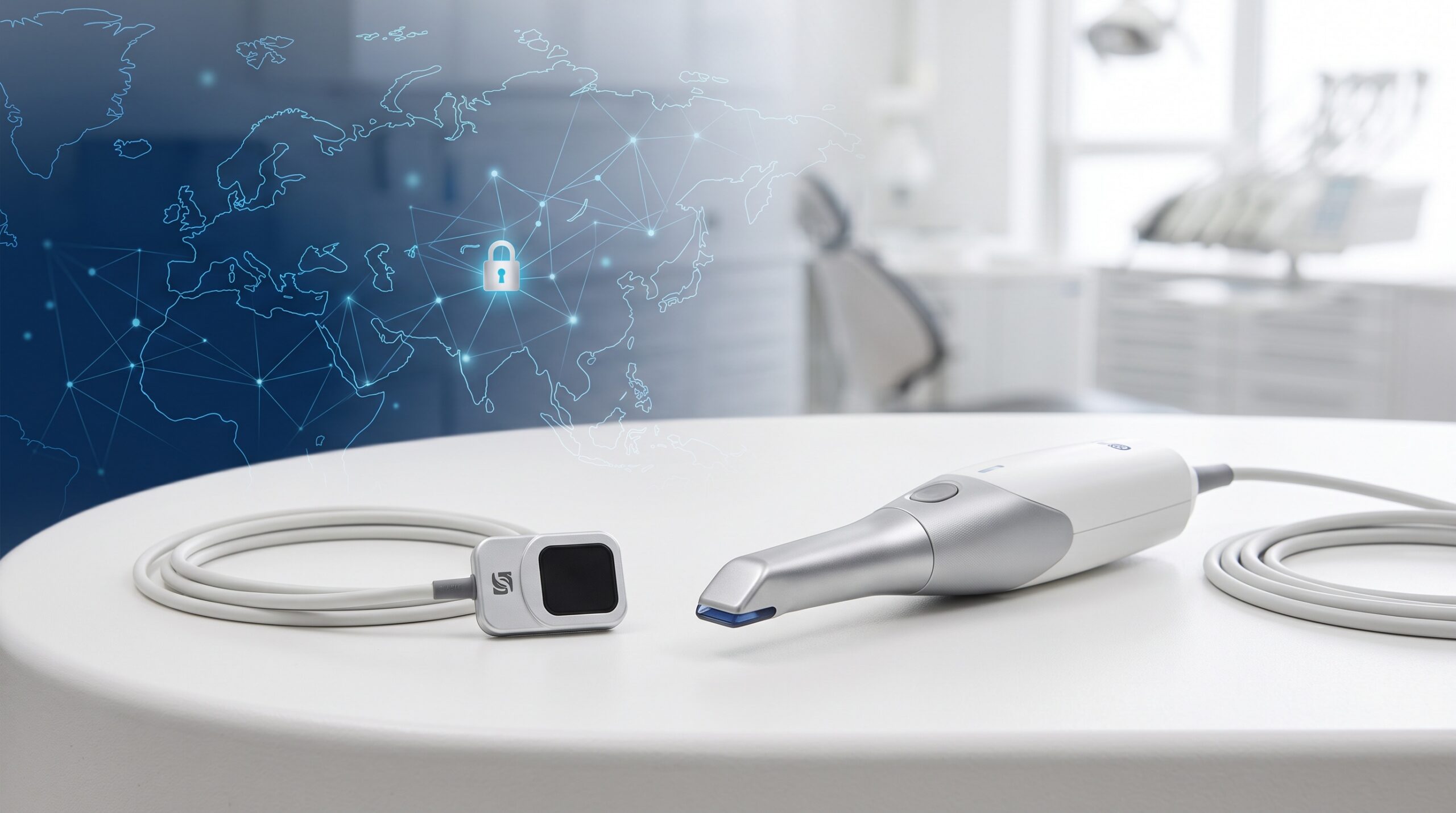
November 2, 2026 A State Just Started Auditing Chinese-Made Medical Devices: What It Means for Your Dental Imaging Hardware
According to recent reporting, Texas has ordered its state agencies to conduct a cybersecurity review of the Chinese-made medical devices running on their networks. Whatever that review ultimately finds, the headline alone raises a question that almost no dental practice asks at the one moment it matters — the moment of purchase: where was this device made, who wrote its firmware, and what is it allowed to talk to once it is plugged into my network?
For years, device provenance was treated as a procurement detail somewhere below price and image quality. It is now a security question, and governments are starting to treat it as one. A dental office does not need a state mandate to take the same prompt seriously — it just needs to understand why the conversation changed.
Why governments are suddenly auditing where devices come from
A modern medical or dental device is not a passive instrument. It is a small networked computer: an X-ray sensor, an intraoral scanner, a cone-beam CT unit, or a vitals monitor, each running an embedded operating system and firmware, each capable of reaching out across your network and, in many cases, out to the internet for "updates," telemetry or cloud features.
That capability is useful. It is also a channel. When the people who wrote a device’s firmware are outside your jurisdiction, outside your vendor contracts, and potentially subject to a foreign government’s data-access laws, the device becomes a question of trust that no amount of image resolution answers. State-level reviews like the one reported in Texas are simply formalising that concern for public agencies. The underlying risk is identical for a private dental practice — it just does not come with a press release.
The backdoor that made this real: the Contec monitor case
This is not hypothetical. In early 2025, the U.S. Cybersecurity and Infrastructure Security Agency (CISA) published an advisory on the Contec CMS8000, a widely used, Chinese-manufactured patient monitor. Researchers found the device contained a hidden backdoor: it quietly sent patient data to, and could pull instructions from, a hard-coded remote address — behaviour no hospital had configured, consented to, or could see.
That is the shape of the modern supply-chain risk. The device did its clinical job perfectly while doing something else entirely in the background. You cannot spot that by looking at the images it produces or the box it shipped in. It lives in the firmware, and it travels with the hardware. We have written before about why device provenance is now a dental practice security question, and the Contec case is the clearest proof yet that the worry is grounded in real findings, not speculation.

Your dental imaging hardware is part of this conversation
Dentistry runs on connected devices. Digital radiography sensors, panoramic and cone-beam CT units, intraoral scanners and milling units all sit on the practice network, and a growing share of them are manufactured — in whole or in part — overseas, often in China, regardless of the Western brand on the label. That is not an accusation against any one manufacturer; it is simply the reality of a global hardware market.
The point is not to panic or to rip out working equipment. It is to recognise that every one of those devices handles protected health information under HIPAA and personal health information under Ontario’s PHIPA, and that each one is an endpoint whose software you did not write and cannot fully inspect. They belong in your risk assessment alongside your servers and workstations — a surface we covered in our look at the connected-device attack surface in a dental practice.
The questions to ask before you buy — and keep asking
Provenance belongs on the purchase order, not in the post-incident report. Before you acquire a new imaging device — and when you review the ones you already run — put these questions to the vendor and get the answers in writing:
- Where is the device and its firmware actually manufactured and maintained? "Designed in" is not "built in," and the firmware’s authorship matters more than the logo.
- Does it meet current regulatory cybersecurity requirements? In the U.S., newer devices must satisfy the FDA’s Section 524B premarket cybersecurity rules — a useful bar even for Canadian buyers. Our note on FDA 524B and dental imaging purchasing explains what to look for.
- What does it connect to, and can that be turned off? Ask for a list of the external addresses and services the device contacts, and whether cloud or telemetry features can be disabled without breaking clinical function.
- Who ships security updates, how often, and for how long? A device that will stop receiving firmware patches in two years is a liability with a countdown on it.
- Is there a Software Bill of Materials (SBOM)? Reputable manufacturers can now provide one — a list of the components inside the firmware, which is how known vulnerabilities get found before attackers find them.
What to do about the devices already on your network
You almost certainly cannot replace every device whose provenance you are unsure of, and you do not need to. The practical defence is containment: assume any connected device could misbehave, and build the network so that it cannot reach anything it has no business reaching.
That means segmenting imaging and clinical devices onto their own isolated network, away from your general workstations, email and internet browsing, so a compromised device is boxed in rather than handed the keys to the practice. It means restricting outbound connections at the firewall so a device phoning home to an unexpected address is blocked and logged. And it means watching the traffic — a device that suddenly starts talking to a server it never contacted before is exactly the signal you want to catch. This is the discipline we laid out in our guide to segmenting legacy imaging devices, and it protects you regardless of where any individual device was made.


The state review making headlines will run its course. The lesson for a dental practice outlasts the news cycle: the devices you trust with patient images are computers you did not build, and provenance, patch support and network containment are now part of buying and running them responsibly.
How Compudent can help
Compudent Systems helps dental practices across the GTA and Ontario bring imaging and clinical devices into a sound security posture: provenance and vendor-risk review before you buy, network segmentation that isolates imaging hardware, firewall rules that catch a device talking where it should not, and monitoring that fits a dental office rather than a hospital IT department. If you are not sure what your imaging devices are connected to — or where they were made — contact us for an assessment, and we will help you answer those questions before someone else does.
Sources & further reading:
- Texas orders cybersecurity review of state agencies’ Chinese-made medical devices
- CISA ICS Medical Advisory ICSMA-25-030-01: Contec CMS8000 patient monitor backdoor
- FDA: Cybersecurity in Medical Devices (Section 524B premarket requirements)
Related Reading
- Where Was Your Imaging Sensor Made, and What Is It Talking To? Device Provenance Is Now a Dental Practice Security Question
- One Screen for Scans and X-Rays: What Medit’s AuraVue With Overjet AI Means for Your Dental Practice
- Medtronic Data Breach by ShinyHunters: Critical Warning for Medical Device Security in Dental Practices