



October 21, 2026 Dental AI Imaging Just Went Cloud-Native: The IT Due-Diligence Checklist Before You Let Pearl, Overjet or DS Core Read Your X-Rays
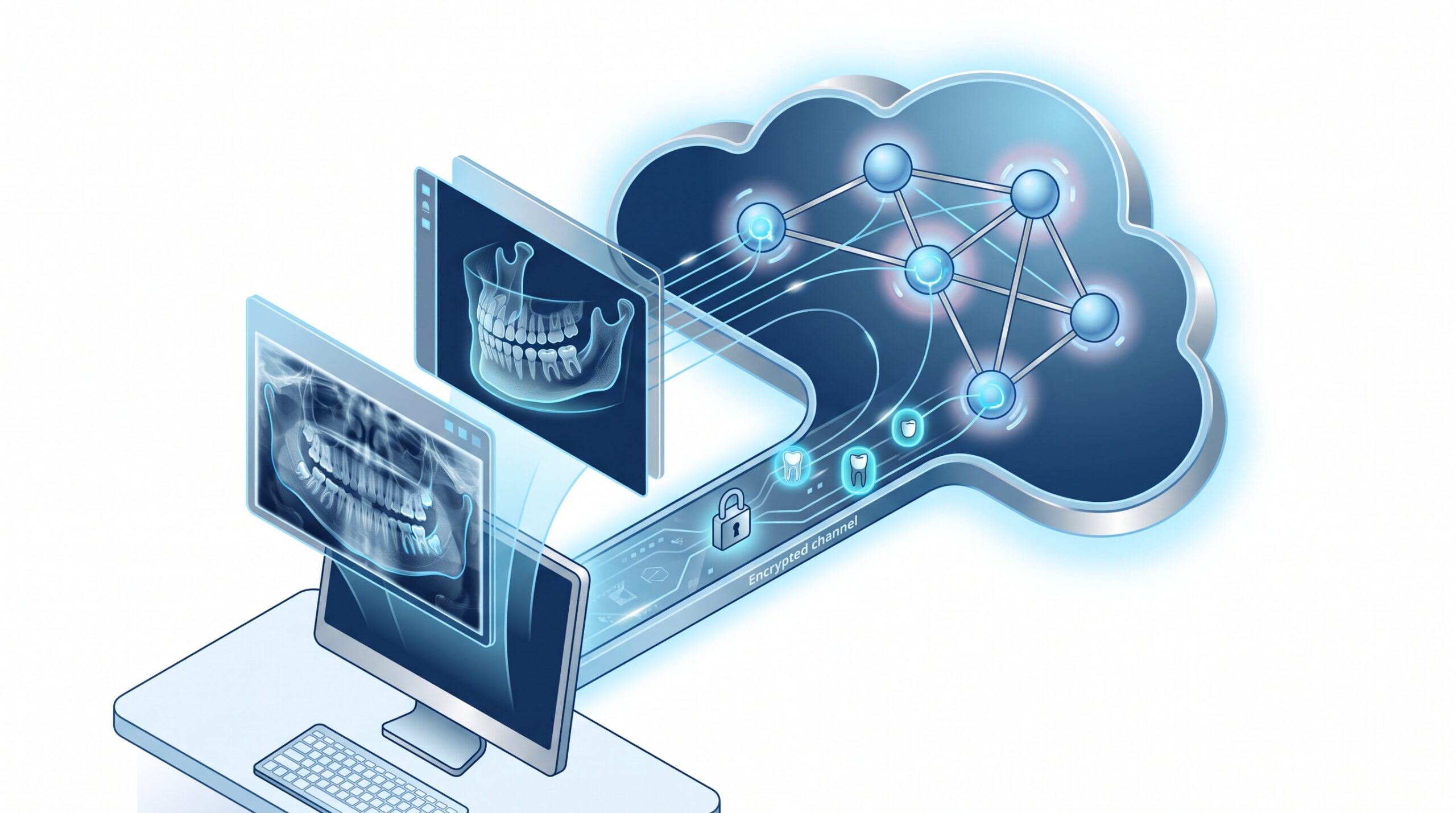
For years, artificial intelligence that reads dental radiographs was something you watched in a demo and filed under “someday.” This quarter, someday arrived — and it arrived in the cloud. Pearl brought its imaging AI to general dentists as a shipping product and began building it natively into a new cloud practice-management platform; Overjet’s chairside caries-and-bone-loss analysis rolled into hundreds more offices through practice-management partnerships; and Dentsply Sirona made an FDA-cleared tool that flags findings on CBCT scans available through its DS Core cloud for existing and new cone-beam systems. The common thread is not the clever model. It is that all of it now runs as a cloud service, not as software sitting on one operatory PC.
The clinical pitch is genuinely strong, and it is easy to say yes to: a second set of eyes on every radiograph, cavities and bone loss highlighted chairside, more confident case presentation. But the moment a practice turns one of these on, something quieter happens underneath — your patients’ images start leaving the building. That makes this an IT and privacy decision first and a clinical one second, and it deserves the same due diligence you would give any vendor you hand a copy of your patient records to.
What actually changed this quarter
It is worth being precise about the shift, because the marketing blurs it. The tools themselves are not new ideas — AI caries detection and CBCT finding-detection have been demoed for years. What changed is distribution: these capabilities are now packaged as cloud subscriptions wired directly into mainstream practice-management and imaging platforms, so adopting them is a few clicks rather than a server install. Pearl’s launch of a commercial 3D reading product for general dentists, its partnership to embed AI into a cloud all-in-one platform, and Dentsply Sirona delivering an AI tool through DS Core all point the same direction. The friction to turn it on has collapsed. The friction to turn it off — once your images and findings live on someone else’s servers — has not.

The quiet part: your radiographs now leave the premises
A cloud AI service cannot read an image it never sees. To return a result, the platform receives a copy of the radiograph — and a dental X-ray tied to a patient’s chart is personal health information the instant it crosses your firewall. That is not a reason to avoid these tools; it is a reason to know exactly what you are agreeing to. Where is that copy stored, and in which country? Is it kept after the analysis is done, or discarded? Is it used to train the vendor’s future models? Who at the vendor can open it? “The AI reads our X-rays” is a sentence that hides four or five separate data-handling decisions, and in a practice you are the one accountable for each of them.
The due-diligence checklist before you switch it on
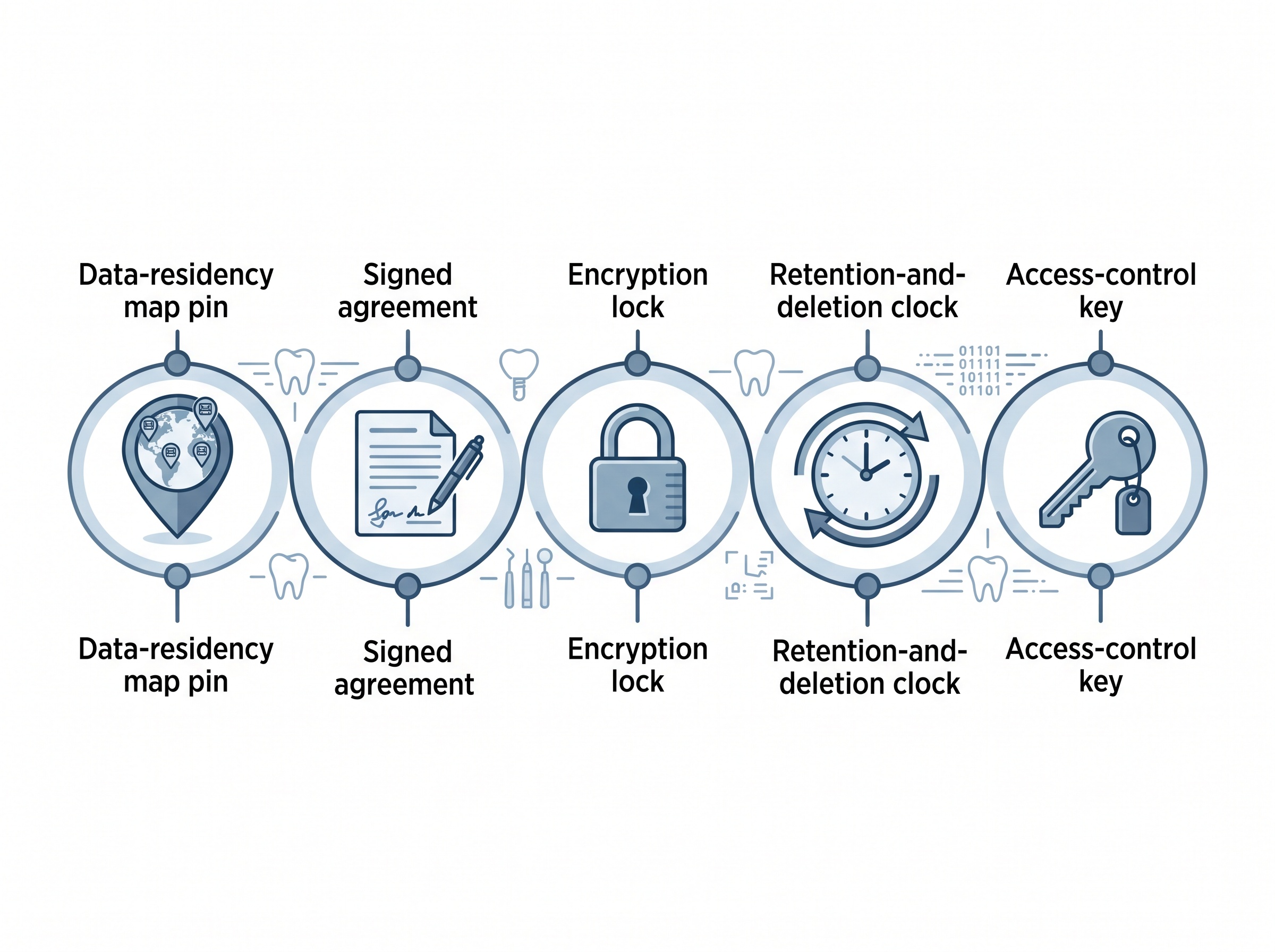
Treat a cloud imaging-AI vendor exactly like any other party you disclose patient data to. Before the first scan uploads, get clear answers — in writing — to five questions:
1. Data residency. Where physically are the images and findings stored and processed? For Ontario and Canadian practices, data crossing into U.S. or other jurisdictions carries obligations and disclosure expectations you need to understand up front, not discover later.
2. A real agreement that names responsibility. There should be a signed contract — a business associate agreement under HIPAA, or the equivalent service and privacy terms under Canadian law — that spells out the vendor’s security obligations and breach-notification duties. If a vendor cannot or will not sign one, that is your answer.
3. Encryption, in transit and at rest. Images must be encrypted on the way up and while stored. Confirm it; do not assume it.
4. Retention, deletion, and training use. How long are your images kept, can you have them deleted, and are they used to train models? If images feed training, insist on knowing whether they are de-identified and whether you can opt out.
5. Access and audit. Who can view your data, how is their access logged, and can you get an audit trail if a question ever arises?
Bandwidth and workflow are not an afterthought
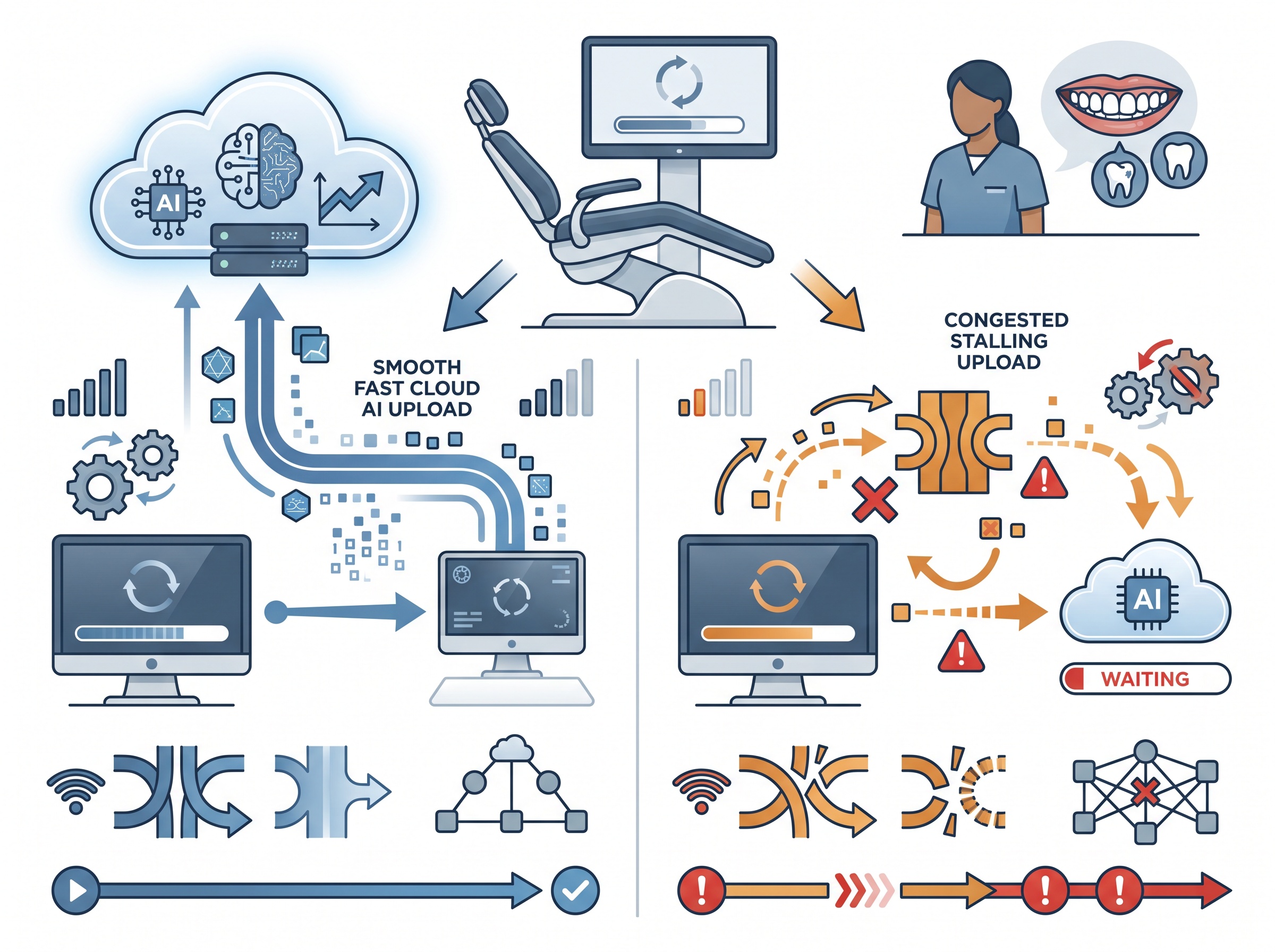
Cloud AI is only as “chairside” as your internet connection. Real-time reading means uploading image data and waiting for a result while the patient is in the chair — and a 3D CBCT volume is a large file. On a weak consumer link, or a connection the whole office is already straining, that “instant” second opinion becomes a spinning wheel at exactly the wrong moment. Before you commit a clinical workflow to a cloud service, make sure the connection underneath it is business-grade and resilient, with enough upload headroom for imaging and a plan for what happens when the link drops. And because these tools have to plug into the imaging software you already run, the integration can be just as fragile as the connectivity — the same mismatch headaches we described in our explainer on imaging bridge software and why X-rays break when you switch practice-management systems apply when you bolt a new AI layer onto an existing stack.
Consent, the record, and the regulators
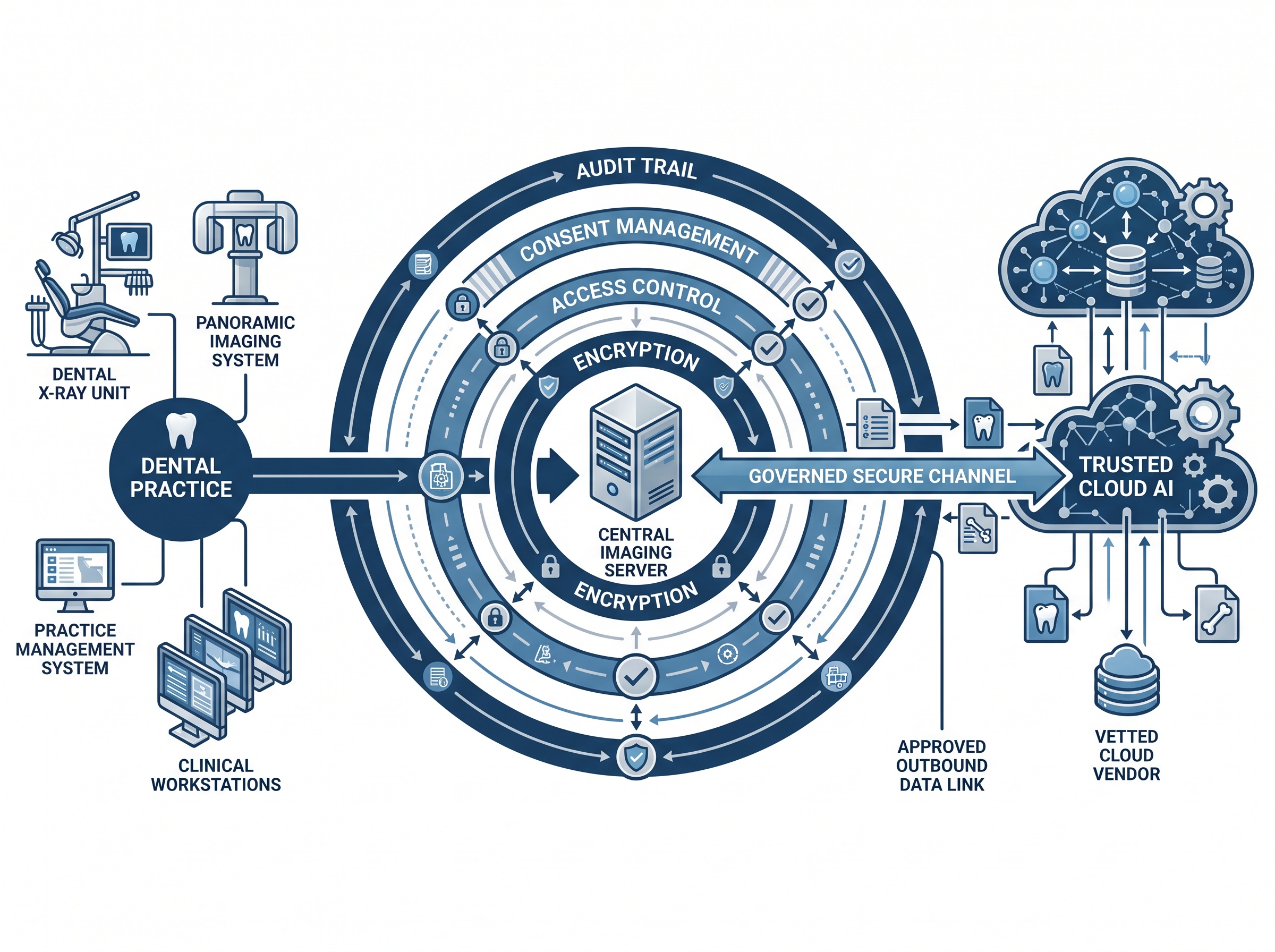
Sending a patient’s images to a third-party AI for analysis is a disclosure of personal health information, and it sits inside the same privacy framework as any other. In Ontario, the Personal Health Information Protection Act (PHIPA) expects disclosures to be limited to what is reasonably necessary and handled by accountable parties; practices serving U.S. patients also answer to the HIPAA Security Rule. There is a records angle too: AI findings become part of how you document and justify clinical decisions, which lands squarely on the documentation discipline we covered when the profession moved toward scanning less and recording why. And if you ever need to send that imaging to a specialist for a human second opinion, the same secure-channel rules from our guide to sharing a 3D scan without putting a patient’s record at risk still apply — a cloud AI in the loop does not relax them.
It is an IT decision before it is a clinical one
None of this is an argument against adopting AI imaging. The tools are maturing fast, the diagnostic help is real, and patients respond well to seeing findings mapped on their own radiographs. It is an argument for adopting them deliberately — the same way a practice should approach any technology that reshapes where patient data lives. We made this case about another emerging modality when we wrote that dental MRI is an IT project before it is a clinical one, and cloud AI imaging is the same story at higher speed: the clinical value is obvious, and the infrastructure, privacy, and vendor questions are what determine whether it helps your practice or quietly exposes it.
How Compudent helps
Compudent helps dental practices across the GTA and Ontario adopt cloud imaging and AI tools without taking on hidden risk — vetting vendors and their data-handling terms, confirming encryption, residency, and agreements before patient images ever leave your network, and making sure the connectivity and integration underneath can actually carry a chairside workflow. If an AI imaging tool is on your shortlist, let’s run the due diligence before you switch it on, not after. Contact Compudent to review a cloud AI imaging vendor and the IT around it.
Sources & further reading:
- Becker’s Dental — dental technology and AI updates (Q3 2026 roundup)
- Information and Privacy Commissioner of Ontario — Personal Health Information Protection Act (PHIPA)
- HHS — HIPAA Security Rule and business associate guidance
Related Reading
- One Screen for Scans and X-Rays: What Medit’s AuraVue With Overjet AI Means for Your Dental Practice
- How Dental AI Tools Connect to Your Imaging Software: TWAIN, DICOM, API, and PMS Bridges
- AI That Reads Your CBCT Scans Just Arrived for General Dentists: What Pearl’s Second Opinion 3D Means for Your Practice