




August 19, 2026 Public Exploit Code Is Now Out for a Critical SCCM Flaw: What CVE-2026-47301 Means If Anyone Manages Your Practice’s Windows Fleet
Most of the security alerts a dental practice hears about concern a single program on a single computer: patch this browser, update that PDF reader, replace this end-of-life app. This one is different, and the difference is worth a minute of your attention. The flaw disclosed as CVE-2026-47301 sits in the software some organizations use to manage all of their Windows computers at once. When the thing that controls every machine is the thing that gets compromised, the problem is not one workstation. It is potentially the whole fleet.
Microsoft issued a fix for this vulnerability in its Configuration Manager product, better known as SCCM, back on July 14, 2026. For a month it stayed a theoretical concern. That changed this week: a security researcher published a working proof-of-concept exploit that demonstrates the full attack from start to finish. A patched, quietly-known flaw and a patched flaw with public exploit code circulating are two very different risk levels, and defenders are now on the clock.
First, does this even apply to your practice?
Let us be honest and specific, because vague alarm helps no one. SCCM, now formally Microsoft Configuration Manager, is enterprise fleet-management software. A single dentist running four computers and a server almost certainly does not have it. It is the kind of tool you find where dozens or hundreds of Windows machines need to be managed centrally: patched, imaged, inventoried, and issued software from one console.
In the dental world, that means this alert is aimed squarely at three groups. First, multi-location dental groups and DSOs with enough scale to justify centralized endpoint management. Second, the managed IT providers and MSPs that run fleets of practice computers on their clients’ behalf. Third, larger clinics and imaging centres whose IT was built out on a Microsoft-managed backbone. If none of that describes your setup, you can read this as background. If any of it does, or if you are not sure whether your IT provider uses SCCM, this is a question worth asking today.
What the flaw actually is, in plain terms
CVE-2026-47301 is not a single mistake but an exploit chain: several smaller weaknesses linked together so that each one hands off to the next. On its own, no single link is a catastrophe. Chained, they let an ordinary authenticated domain user, an account with no special privileges, climb all the way to SYSTEM-level code execution on the SCCM Primary Site Server. SYSTEM is the highest level of control a Windows machine has. On the server that manages your fleet, it is effectively the keys to everything.
The researcher’s chain strings together a broken-authorization flaw that lets a normal user reach an endpoint they should not, a file-upload path-traversal that writes a file where it does not belong, a certificate-verification bypass, and finally a DLL hijack that runs the attacker’s code. You do not need to follow the mechanics to grasp the shape of it: a low-privilege foothold becomes total control of the one server that talks to every managed computer.

This is the same pattern we have flagged before in a different Microsoft component, when an ordinary account could be leveraged into full takeover of a Windows domain through a certificate-services weakness. The lesson repeats: in a Windows environment, the distance between a modest user account and complete control is often shorter than it looks, and attackers are experts at closing it.
Why the management server is the worst place to be compromised
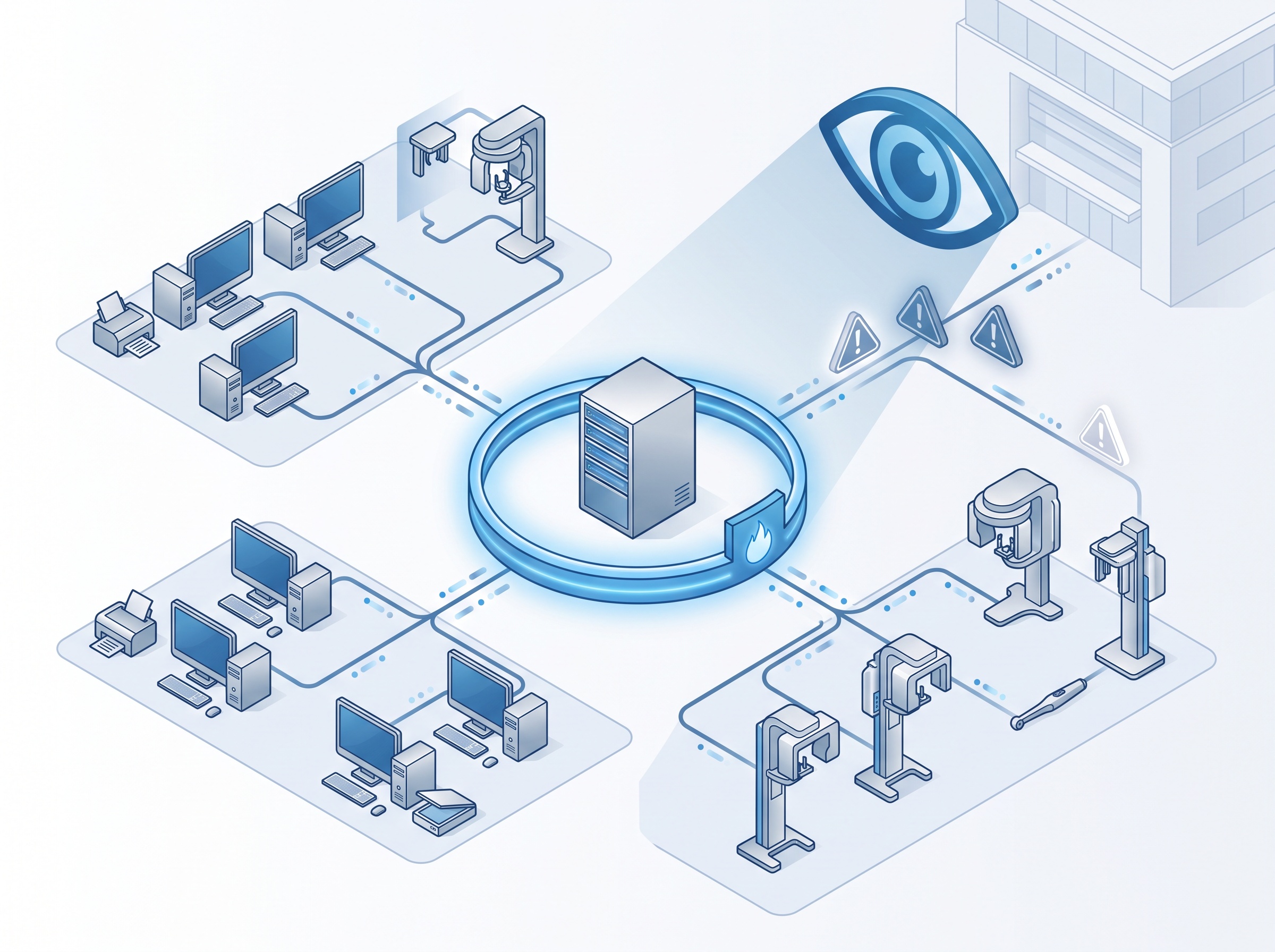
Here is what makes this class of flaw genuinely serious for a healthcare network. The entire purpose of a tool like SCCM is to push software and commands to every machine it manages. That is its job on a good day. An attacker who owns that server inherits that same capability. Instead of ransoming one computer, they can potentially distribute their payload to every endpoint in the fleet through the trusted management channel, the one your own systems are built to obey without question.
For a single practice that would be devastating. For a group or an MSP managing many practices from shared infrastructure, one compromised management server could reach across multiple clinics at once. The convenience of central management and the blast radius of a central compromise are, unavoidably, the same wire. That is not an argument against central management, which is genuinely good practice; it is an argument for defending the center of it as if everything depended on it, because it does.

It is the same reason a breach of a remote-management platform is so damaging. We saw exactly this dynamic when a widely used remote monitoring and management tool used by MSPs was breached: the tools that give IT its leverage give an intruder the same leverage if they are turned.
What to do about it, in order
1. Confirm whether SCCM is in your environment at all. If you run your own IT, check whether Microsoft Configuration Manager is deployed. If a provider manages your computers, send them one direct question: “Do we use SCCM or Microsoft Configuration Manager, and if so, are we patched against CVE-2026-47301?” A competent provider will answer quickly and specifically.
2. Apply the July fix immediately if you have not. Microsoft’s update from July 14, 2026 closes the initial authorization flaw that the whole chain depends on. If your Configuration Manager is current, you have already broken the chain at its root. If it is not, this is the priority patch, not a next-maintenance-window item, now that exploit code is public.
3. Restrict who can even reach the server. The exploit needs an authenticated user to start. Tightening which accounts can talk to the management server, enforcing least privilege, and putting it behind proper network segmentation all raise the bar even against future flaws. A management server should not be casually reachable from every workstation on the network.
4. Make sure you could recover. Any whole-fleet threat is ultimately a test of your backups. This is a good moment to confirm that your recovery plan is real and that your backups have been tested with an actual restore, not merely assumed to work. A management-server compromise is precisely the scenario where a proven backup is the difference between a bad week and a closed practice.

The compliance angle you cannot skip
Under both HIPAA and Ontario’s PHIPA, you are responsible for safeguarding patient information with reasonable, current measures, and that responsibility does not evaporate because your computers are managed by someone else. If a management server your practice relies on is compromised and patient data is exposed, “our IT provider handles that” is not a defence; due diligence over your vendors is part of the obligation. A public exploit for a known, patchable flaw is exactly the kind of thing a regulator would expect a diligent practice, and its IT partner, to have addressed promptly.
The bottom line for your practice
CVE-2026-47301 is a critical flaw in the software some dental groups and their IT providers use to manage entire fleets of Windows computers, and as of this week there is public exploit code that turns it from theory into a usable attack. Microsoft’s fix has been available since July. The action is simple to state: find out whether SCCM is anywhere in your environment, confirm it is patched, tighten access to the management server, and make sure your backups would actually bring you back. If your practice is part of a group, or your machines are managed by an outside provider, the single most useful thing you can do today is ask them, directly, whether you are covered.
If you would like an independent set of eyes on how your practice’s computers are managed and whether flaws like this one are being patched on your behalf, contact Compudent Systems. We help dental practices and groups across Ontario understand what is running their networks, confirm the important updates are actually applied, and reduce the blast radius before a known flaw becomes an incident.
Sources & further reading:
- Public Exploit Code Released for Microsoft SCCM Remote Code Execution Vulnerability (CVE-2026-47301)
- XM Cyber: Potential for Remote Code Execution in Microsoft SCCM via Newly-Discovered Exploit Chain
Related Reading
- When the Tool That Manages Your Network Gets Hacked: The N-able N-central Breach and What It Means for Dental Practices
- One Ordinary Login Can Now Own Your Whole Network: What the ‘Certighost’ Windows Domain Exploit Means for Dental Practices
- 974 Patches, Two Being Exploited Right Now: How a Dental Practice Should Read September’s Patch Tuesday