




September 29, 2026 The Breach Vector Hiding in Your Practice Management Software: SQL Injection Explained for Dental Offices
When security researchers disclosed that attackers had pulled patient records straight out of a medical software provider’s systems using nothing more exotic than an SQL injection flaw, it landed as a pointed reminder for every dental practice: the biggest risk to your patient data is not always a dramatic ransomware detonation. Sometimes it is a quiet, decades-old web vulnerability sitting inside the very software your front desk uses all day.
SQL injection is one of the oldest tricks in the book, and it remains one of the most damaging. For a dental office holding thousands of patient records, understanding this attack is not academic — it is the difference between a routine day and a reportable PHIPA breach.
What SQL injection actually is
Almost every piece of practice management, imaging, or patient-portal software stores its information in a database. When a staff member searches for a patient, books an appointment, or a patient fills out an online form, the software builds a database query behind the scenes to fetch or save that information.
SQL injection happens when an attacker types database commands into an ordinary input field — a login box, a search bar, an online form — and the software, failing to separate data from instructions, runs those commands as if they were legitimate. In effect, the attacker starts talking directly to your database. Depending on the flaw, that can mean reading every patient record, dumping the entire table, altering data, or even deleting it.
Why dental practices are squarely in the blast radius
Dental software is a rich target for one simple reason: the database behind it is a concentrated vault of exactly the data criminals want. Names, dates of birth, addresses, insurance and government identifiers, and complete clinical histories often sit in a single connected system.
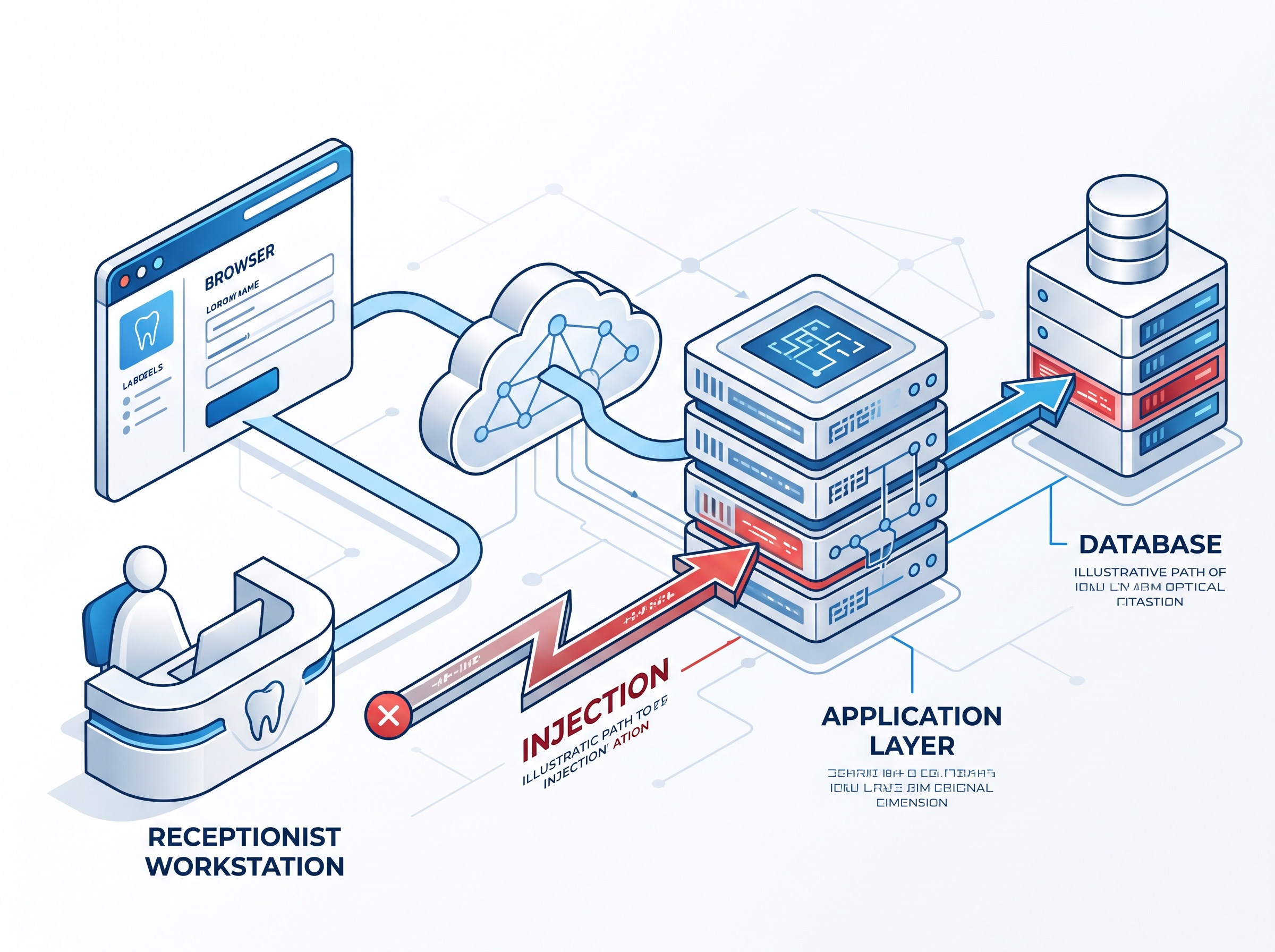
Three factors make injection risk higher than most practices assume:
- Third-party dependence. You did not write your practice management software, and you cannot see its source code. If the vendor left an injectable field somewhere, you inherit that risk without ever knowing it exists.
- Internet-facing components. Online booking, patient portals, and cloud dashboards expose input fields to the entire internet, where automated scanners probe for injection flaws around the clock.
- Long upgrade cycles. Clinical software is often left on older versions to avoid disrupting the schedule, so known vulnerabilities can linger for months after a fix is available.
What an attack looks like in a real office
An injection attack rarely announces itself. There is no ransom note and no locked screen. An attacker — frequently an automated bot — finds a vulnerable field, extracts the patient database, and leaves. The first sign of trouble often arrives weeks later, when the records surface for sale on a criminal marketplace or a regulator comes calling.

That silence is precisely why injection breaches are so dangerous for a healthcare provider. Under Ontario’s PHIPA and equivalent privacy law, the obligation to safeguard patient information rests with you, the custodian — even when the weak link was your software vendor’s code. A quiet data theft you never detected is still a reportable breach, and the reputational damage to a practice that patients trust with their most sensitive records can be severe.
The defenses that actually stop injection
The good news is that SQL injection is a thoroughly solved problem when the right controls are in place. The heavy lifting happens at two layers: the software itself and the network around it.

- Parameterized queries. Well-built software separates user input from database instructions so a form field can never be executed as a command. This is the vendor’s responsibility — and a fair question to put to yours.
- A web application firewall (WAF). A WAF inspects incoming traffic to your portals and cloud apps and blocks the tell-tale patterns of an injection attempt before they ever reach the database.
- Least-privilege database accounts. If the account your software uses can only read what it needs, a successful injection yields far less than a full-access account would.
- Prompt patching. The single most reliable defense is keeping practice management, portal, and server software current, because most exploited flaws already have a fix waiting.
Questions every practice should ask its software vendor
Because so much of this risk lives in code you do not control, vendor diligence is a core part of your security program — not an afterthought. Before you renew or sign, ask directly:
- How do you test your software for injection and other web vulnerabilities, and how often?
- What is your patch timeline once a security flaw is discovered?
- Is our patient data encrypted at rest in the database, and who holds the keys?
- Do you carry independent security certifications or third-party penetration test reports you can share?
A vendor that answers these clearly is protecting you. A vendor that cannot is a risk you are carrying on their behalf.
Turning a breach into a non-event
Even with strong defenses, the goal is resilience: assume something will eventually slip through and make sure it cannot become a catastrophe. That means monitored, tested, offline-capable backups so data can be restored cleanly, network segmentation so a compromised web app cannot roam your whole practice, and logging that would actually surface unusual database activity rather than letting it pass unseen.

SQL injection is old, but the patient records it targets have never been more valuable. The practices that stay out of the headlines are the ones that treat their software supply chain, their web-facing apps, and their backups as a single, continuously maintained security posture.
How Compudent Systems can help
At Compudent Systems, we help dental practices across the GTA and Ontario harden exactly these weak points — assessing your practice management and imaging software, deploying web application firewalls and network segmentation, tightening database and access controls, and standing up monitored backups that make recovery routine. If you are not certain whether your patient database is exposed, that uncertainty is the problem. Contact Compudent Systems for a security assessment and let us confirm your patient data is protected the way PHIPA expects.
Sources & further reading:
- Hackers exploit SQL injection flaw to steal patient data from medical software provider
- OWASP: SQL Injection
Related Reading
- No Malware Required: How an "IDOR" Flaw in Dental Software Exposed Patient Records — and the Questions to Ask Your Vendor
- Dentrix, Eaglesoft, Open Dental: Why One Patching Policy Cannot Cover All Three
- The Breach Almost Always Starts With a Click: How to Run Security-Awareness Training and Phishing Tests in a Dental Practice