



August 18, 2026 Dentrix Just Stopped Supporting Windows 10: What Every Practice Still Running It Needs to Do Now
For most of a dental practice, the operating system underneath the software is invisible. Staff open Dentrix, check the schedule, post a claim, pull up a patient’s radiographs, and close the day. Nobody at the front desk thinks about which version of Windows is doing the work. That is exactly why the change that took effect this summer is so easy to miss, and so important to act on.
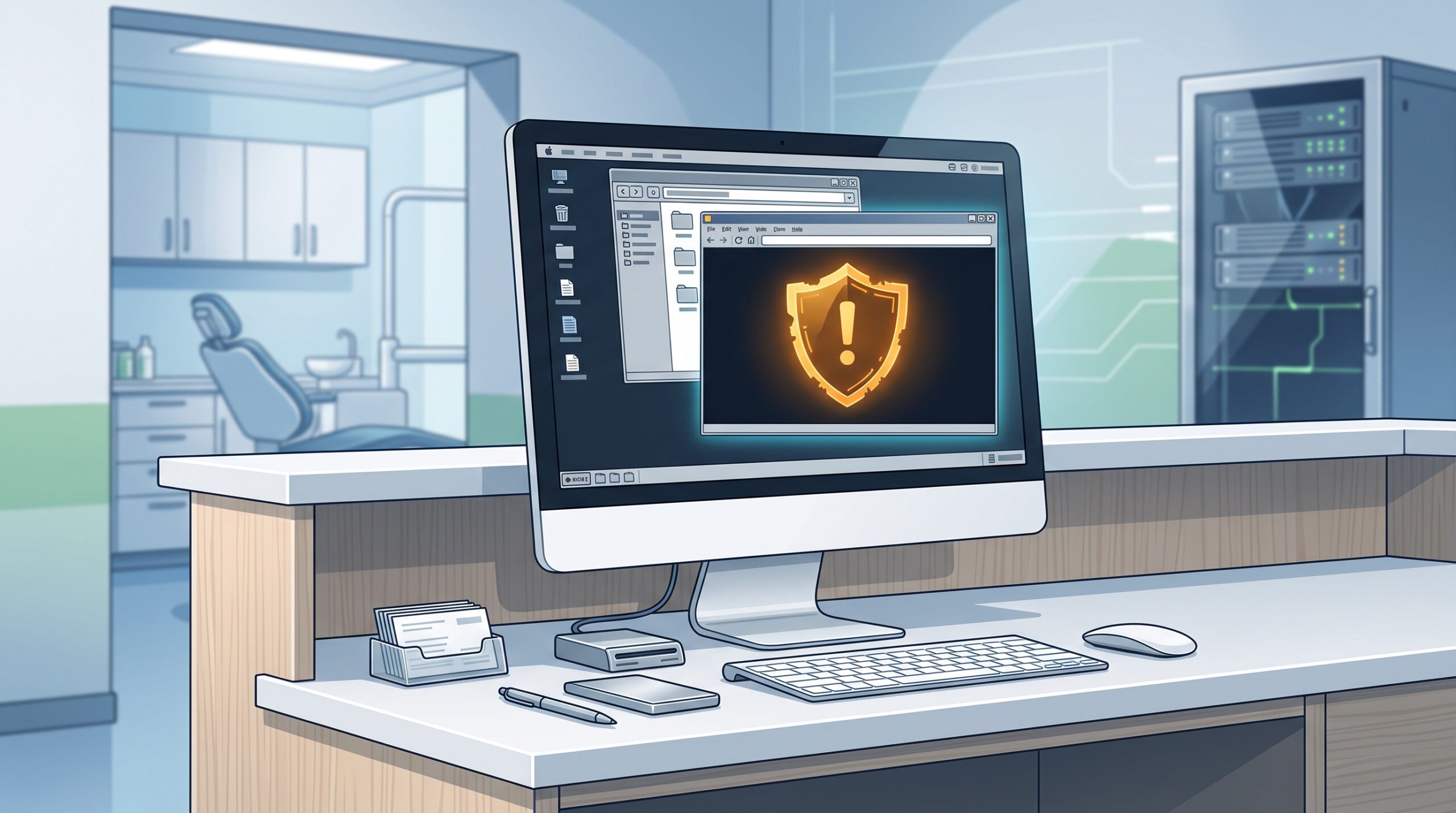
There are now two deadlines stacked on top of each other, and both have already passed. Microsoft ended support for Windows 10 on October 14, 2025. And Henry Schein One, the company behind Dentrix, set June 30, 2026 as the date after which it will no longer support new Dentrix installations on Windows 10. If your practice is still running Dentrix on a Windows 10 machine today, you are no longer running a merely aging setup. You are running an unsupported, end-of-life configuration that neither the operating system vendor nor the software vendor stands behind.
What actually changed, in plain terms
The two deadlines are related but separate, and it helps to keep them straight.
The first is the operating system itself. When Microsoft ends support for a version of Windows, it stops shipping the monthly security updates that close newly discovered vulnerabilities. The machine keeps working, but every flaw found after that date stays open on it, permanently. We covered that shift and why an unsupported operating system is already a HIPAA and PHIPA problem in detail. That risk applies to any Windows 10 machine, in any industry.
The second deadline is new, and it is specific to your practice management software. Henry Schein One has now drawn its own line: Dentrix is no longer supported on Windows 10. In practice, that means if you call for help with a Dentrix problem on a Windows 10 workstation, or need to reinstall or set up a new machine, the supported answer is to be on Windows 11. A vendor that will not support your configuration is a vendor that cannot reliably help you when something breaks, and in a busy practice, something always eventually breaks.
Why a software vendor’s deadline matters as much as Microsoft’s
It would be easy to treat the Dentrix cutoff as a formality. It is not. Dentrix is not a peripheral app. It is the system of record for your schedule, your clinical notes, your billing, and, for many practices, the hub your imaging connects into. When the vendor of that system says it will not support a given operating system, three things follow.
First, troubleshooting gets harder and slower. Support teams are trained and resourced around supported configurations. On an unsupported one, you may be told the fix is simply to upgrade before they can proceed, which is the worst possible moment to discover you are behind.
Second, future updates and integrations are not guaranteed to work. As Dentrix ships new versions and as third-party tools that plug into it evolve, they are built and tested against supported platforms. An unsupported OS is where subtle, hard-to-diagnose failures accumulate.
Third, and most importantly for a healthcare practice, it compounds your compliance exposure. You now have patient health information flowing through software the vendor will not support, running on an operating system the vendor will not patch. Under both HIPAA and Ontario’s PHIPA, you are expected to protect that information with reasonable, current safeguards. Two overlapping end-of-life declarations on the same machine is a difficult thing to defend as reasonable.

The risk is invisible until the day it is not
The trap with all of this is that nothing looks wrong. The Windows 10 machine at the front desk boots up, Dentrix opens, the day runs. There is no lockout, no red screen, no alarm the morning support ended. Meanwhile, attackers actively scan for exactly this profile: a widely deployed, internet-connected, unpatched system holding valuable data.
And it is not just the one machine. In a typical practice network, that Windows 10 workstation shares a LAN with your server, your imaging sensors, and every other PC. Ransomware and intruders rarely need to land on the most important machine. They need to land on the weakest one, and then move.

Step one: find every machine still on Windows 10
You cannot fix what you have not counted. The first task is a complete inventory of every computer that touches the practice: reception, each operatory, the office manager’s PC, any laptop used for remote access, and the imaging capture stations. For each one, record the Windows version and, if it is on Windows 10, whether the hardware is eligible to upgrade to Windows 11 in place.
Windows 11 has real hardware requirements, notably a TPM 2.0 security chip and a supported processor. Some practice machines will upgrade cleanly. Others, especially older imaging-capture PCs chosen years ago for compatibility with a specific sensor, will not, and will need to be replaced. Knowing which is which turns a vague worry into a concrete, budgetable plan.

Step two: protect the data before you touch anything
Migrations are exactly when data gets lost, and a practice’s Dentrix database is not something you want to gamble with. Before any machine is upgraded or replaced, confirm you have a current, verified backup that you have actually test-restored. A backup you have never restored is a hope, not a safeguard. Confirm the backup includes the Dentrix database and any imaging data, and that you know how to bring it back if a migration goes sideways.
This is also the moment to check your Dentrix version itself. Windows 11 support and current Dentrix releases go together; an ancient Dentrix build on a shiny new operating system can create its own compatibility surprises. Plan the OS move and the software version together, not separately.
Step three: migrate in a controlled, phased way
You do not have to do everything in one weekend, and you should not. A sensible sequence is to move the lowest-risk machines first, such as an administrative PC that does not capture images, confirm Dentrix and any peripherals behave, and then work toward the imaging and operatory stations where sensor drivers and integrations need careful testing. Schedule the disruptive steps for evenings or a closed day, and keep the tested backup within reach at every stage.
Throughout, treat this as a security project as much as an IT one. A migration is a natural time to also confirm the basics that protect patient information more broadly, from how staff handle records to how the practice communicates with patients under PHIPA and HIPAA. Doing the OS move without revisiting those habits leaves value on the table.

The bottom line for your practice
Two deadlines have quietly converged. Microsoft has stopped patching Windows 10, and Henry Schein One has stopped supporting Dentrix on it. A practice still running that combination is operating the core of its clinical and administrative work on a configuration that is unsupported on both sides, and that is a cybersecurity and compliance gap that will not announce itself before it is exploited. The fix is well understood: inventory, back up and verify, then migrate to Windows 11 in a phased, tested way.
If you are not certain which of your machines are still on Windows 10, whether they can move to Windows 11, or how to migrate your Dentrix environment without downtime or data loss, that is precisely the kind of assessment Compudent Systems handles for dental practices every day. Contact Compudent Systems for a straightforward review of your workstations and a clear, budgeted plan to get your practice back onto a fully supported footing before the gap costs you.
Sources & further reading:
- Microsoft: Windows 10 end of support
- Dentrix System Requirements: What Changed in 2026 (Henry Schein One June 30, 2026 deadline)
Related Reading
- Still Running Windows 10 at the Front Desk? Why an Unsupported OS Is Now a HIPAA Problem
- February 2026 Patch Tuesday: Six Zero-Day Vulnerabilities Mean Your Dental Office Needs to Update Windows Now
- February 2026 Patch Tuesday: Microsoft Fixes 6 Actively Exploited Zero-Day Vulnerabilities — What Dental Practices Need to Do Now