



September 15, 2026 One Screen for Scans and X-Rays: What Medit’s AuraVue With Overjet AI Means for Your Dental Practice
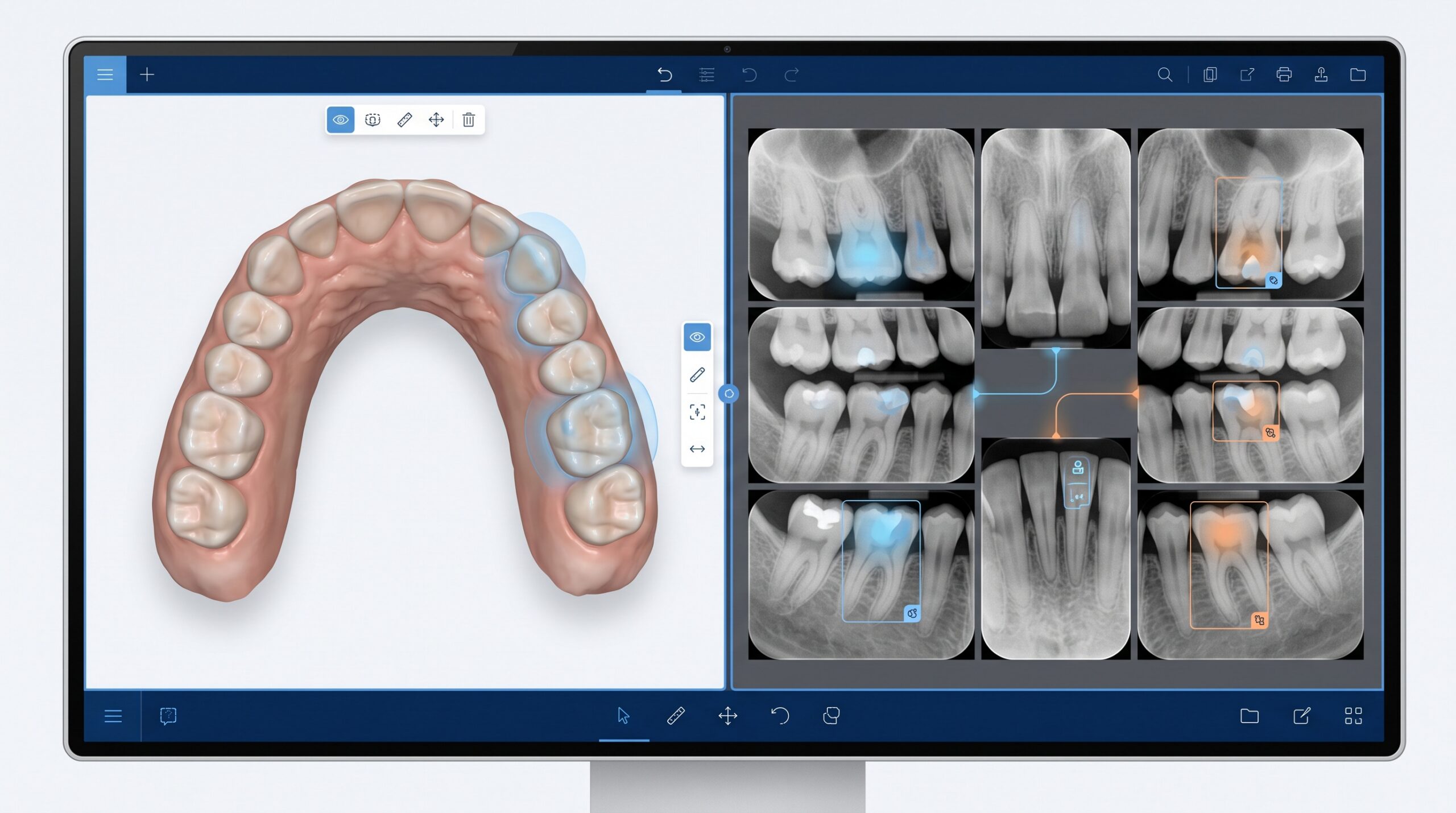
Medit, one of the larger names in 3D intraoral scanning, has launched a new platform called AuraVue, built in partnership with dental-AI company Overjet. The pitch is simple and genuinely appealing: instead of clicking between your scanner software and a separate X-ray viewer, AuraVue puts a patient’s 3D intraoral scan and their radiographs side by side in one interactive workspace, with Overjet’s AI reading the X-rays for findings like decay and bone level. For a profession that has spent years accumulating a drawer full of disconnected imaging programs, a single unified view is a welcome idea. But a new product headline and a good decision for your practice are two different things – so here’s a plain, vendor-neutral look at what AuraVue actually is, and the questions that matter before you adopt it or any AI imaging tool.
What AuraVue actually is
At its core, AuraVue is a visualization workspace. It combines Medit’s 3D intraoral scan data with a patient’s 2D radiographs so a clinician can see both in the same screen rather than in two separate applications. Layered on top of the X-rays is Overjet’s analysis: Overjet is a dental-AI company whose technology automatically reads radiographs to help detect decay and measure bone levels, highlighting areas of interest for the clinician’s review. Overjet is widely used across larger dental organizations and insurers, and its imaging analysis carries US FDA clearance for specific uses. The combination is meant to turn a pile of raw imaging data into a clearer, more visual story – one the dentist can interpret faster and, crucially, one the patient can actually understand.
The problem it’s trying to solve
Two real frustrations sit behind a product like this. The first is workflow friction: in many practices the intraoral scanner has its own software, the sensors and pan/CBCT feed a different imaging suite, and the practice-management system is a third world entirely. Clinicians switch windows, re-open studies, and mentally stitch the pieces together. The second is patient communication. A patient staring at a grayscale periapical radiograph rarely sees what the dentist sees. Put a recognizable 3D model of their own teeth next to that X-ray, with the area of concern visually flagged, and the conversation changes – which is why tools like this tend to be pitched as much for case acceptance as for diagnosis. Those are legitimate wins. The caution is simply that AI-flagged findings are decision support, not a diagnosis: the clinician remains responsible for the read, and a highlight is a prompt to look closely, not a verdict.
The questions that matter more than the demo
A slick unified screen is easy to show in a launch video. Whether it fits a working practice comes down to less glamorous details – and this is where the IT and compliance side earns its keep.
1. Will it actually connect to what you already run?
The single biggest reason imaging tools disappoint is integration. Does the platform work with your existing scanner, sensors and practice-management system, or does it assume you’re all-in on one vendor’s ecosystem? Dental software talks through a patchwork of standards and bridges – TWAIN, DICOM, direct APIs and PMS integrations – and how a new tool plugs in determines whether it saves clicks or adds another silo. We walked through this in detail in our look at how dental AI tools connect to your imaging software; the short version is that “it integrates” is a claim to test with your own setup, not to take on faith.
2. Where does the patient’s image go?
If the AI analysis runs in the cloud – as most modern dental-AI services do – then a patient’s diagnostic images are leaving your building and being processed by a third party. That is not automatically a problem, but it is automatically something you must govern. In Ontario, patient images are personal health information under PHIPA, and sending them to an external processor makes that vendor part of your compliance perimeter. You need to know where the data is stored, who can access it, how long it’s retained, and what happens if the vendor is breached. This is the same vendor-risk discipline we covered in PHIPA, HIPAA and dental AI: a written agreement and clear data-handling answers come before the first image is uploaded, not after.
3. Is it cleared for clinical use where you are?
Overjet’s clearances are US FDA clearances. That does not automatically translate to Canada. A practice north of the border should confirm the tool’s regulatory status with Health Canada and understand exactly which uses are authorized here versus which are informational. It’s a five-minute question to ask a vendor, and the answer tells you a great deal about how carefully they’ve entered the Canadian market.
4. Does it strengthen or complicate your device security?
Adding a cloud AI layer means new connections into and out of your imaging environment – and your imaging environment is often the least-hardened corner of the network, full of appliances that are hard to patch. Any new tool should fit a network you already keep segmented and monitored, not become an excuse to open it up. If your scanners, sensors and older imaging PCs aren’t already isolated appropriately, that’s worth fixing first; we covered the how in keeping legacy imaging devices safely on your dental network.
A practical adoption checklist
- Confirm compatibility with your specific scanner, sensors, CBCT/pan and practice-management system before signing anything.
- Get the data story in writing: a vendor/data-processing agreement, data-residency details, retention and breach-notification terms.
- Verify regulatory clearance for clinical use in Canada, and know which features are diagnostic support versus informational.
- Pilot before you commit: run it on real cases with a couple of clinicians, and measure whether it actually saves time and improves the patient conversation.
- Train the team and set the expectation that AI flags are prompts for review, not final calls.
- Fit it to a secure network: make sure imaging devices and any cloud connections are segmented and monitored.
None of this is a reason to avoid modern imaging tools – the unified-view trend is a real improvement over the disconnected software of the last decade, and it pairs naturally with the broader imaging decisions practices are already making, like choosing between an FMX and a CBCT for a given case. It’s a reason to adopt deliberately.
What this means for your practice
AuraVue is a good signal of where digital dentistry is heading: fewer disconnected programs, more unified views, and AI quietly doing first-pass reads to sharpen the clinician’s eye and the patient’s understanding. For a dental practice, the opportunity is real – and so is the homework. The difference between a tool that pays for itself and one that becomes shelfware usually isn’t the software; it’s whether it fits your existing systems, keeps patient data compliant, and lands on a secure, well-run network. Compudent Systems helps dental practices across Ontario evaluate exactly these decisions – imaging and PMS integration, PHIPA-ready data governance and vendor agreements, and the network security that any cloud AI tool depends on. If you’re considering AuraVue or any AI imaging platform and want a straight answer on whether it will fit and stay compliant, contact Compudent for an imaging and data-governance assessment. We’ll help you adopt the good ideas without inheriting the hidden risks.
Sources & further reading:
- PR Newswire – Medit Launches AuraVue: A Unified 3D Intraoral Scan and X-Ray Visualization Powered by Overjet AI
- Overjet – Overjet Partners with Medit to Launch AuraVue
- Medit – AuraVue product page