




October 19, 2026 AI Just Helped Turn a Linux Bug Into a Root Exploit — and It Shrinks the Window Your Practice Has to Patch
In late July, at the TyphoonPwn 2026 hacking competition, a security researcher named Lee Jia Jie disclosed a working root exploit for a flaw in the Linux kernel. That, on its own, is routine — competitions like this exist to surface exactly these bugs so they can be fixed. The detail that should make every IT decision-maker pay attention was how he built it: he said artificial intelligence helped him find the bug, speed up writing the exploit, and even tune the split-second timing the attack depended on.
The vulnerability itself — tracked as CVE-2026-53264, a use-after-free race condition in the kernel’s network traffic-control subsystem — matters far less than the method. This is a concrete, public demonstration that AI can compress one of the slowest, most specialised steps in an attack: turning a theoretical flaw into a reliable, working exploit. And that compression lands directly on the single defence most dental practices are weakest at — patching before someone shows up to use the hole.
The quiet metric: time from flaw to working exploit
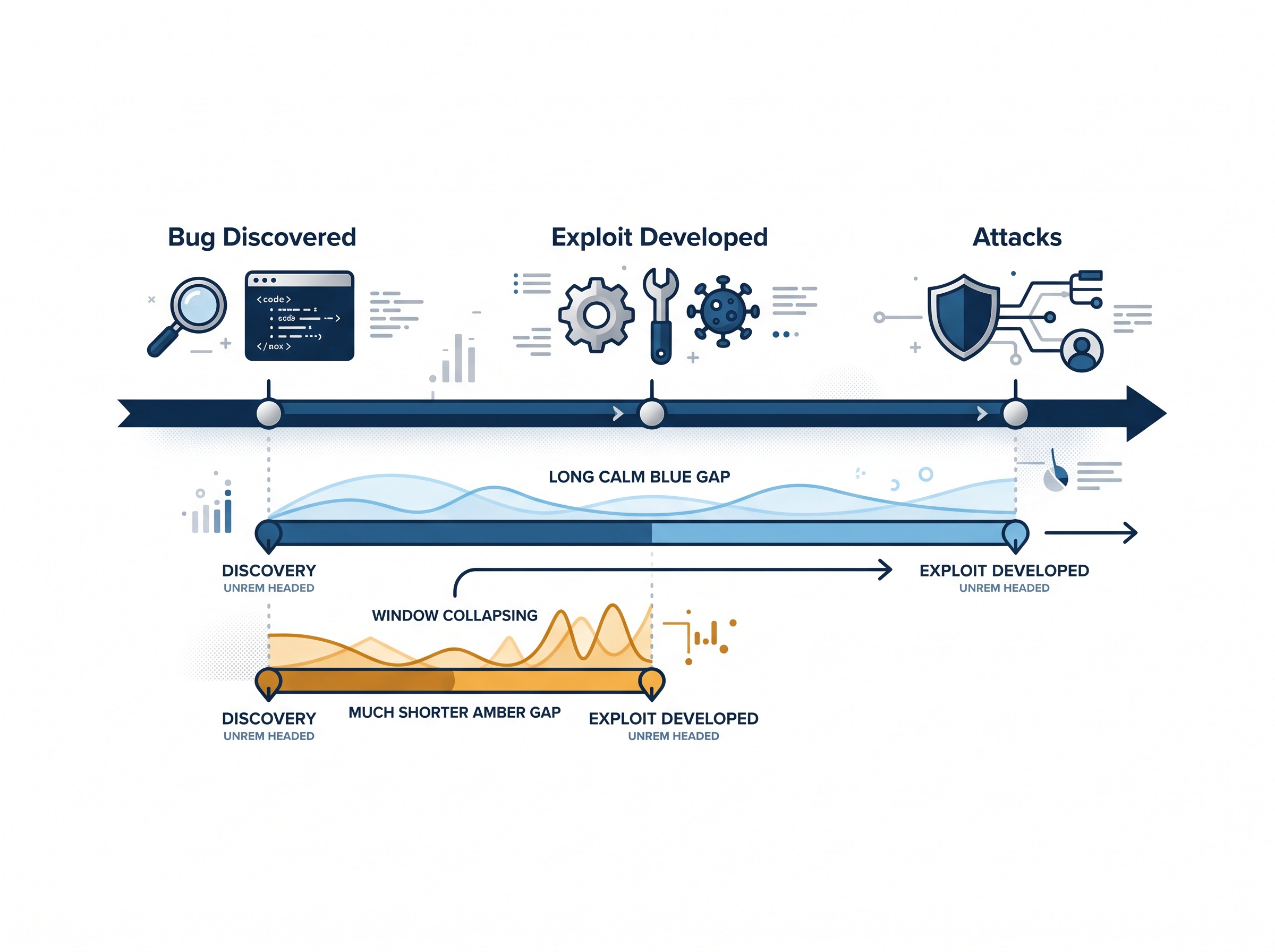
Every security patch you install is really a race against an invisible clock. When a vulnerability becomes public, it is usually just a description of a weakness, not a ready-to-use weapon. Someone still has to do the hard, skilled work of building an exploit that reliably triggers the flaw on real systems. Historically that gap — between “a bug is known” and “a dependable attack exists” — gave defenders breathing room. It was the window in which you could patch and be safe before anyone could realistically use the flaw against you.
That window is the whole game, and AI is shrinking it. The hardest part of the Linux exploit above was the timing: a race condition only works if the attacker hits an incredibly narrow window where the software is briefly in a vulnerable state, and getting that reliable normally takes serious expertise and painstaking trial and error. The researcher used AI to help optimise exactly that. The lesson generalises: work that once took a skilled specialist days or weeks can increasingly be accelerated with AI assistance, which means exploits for newly disclosed flaws will tend to arrive faster.
Keep this in proportion — but take the trend seriously
It is worth being precise, because overstatement helps no one. This particular flaw is a local privilege escalation, not a remote-code-execution bug. In plain terms, an attacker cannot use it to break into your network from the internet; they first need an existing foothold on the machine — a logged-in account, or malware already running with limited rights. Only then does the exploit let them climb from that limited access to full root (administrator) control. So this is not a “the sky is falling” alert about one Linux bug.
The significance is the direction of travel. AI did not invent a new category of attack here; it lowered the effort and skill required to weaponise an existing one. Repeat that across the thousands of vulnerabilities disclosed every year, and the practical effect is that the comfortable gap between disclosure and exploitation gets narrower for everyone — including small healthcare practices that assumed they were too minor, and too slow a target, to be reached before they got around to patching.
Why “we’ll patch it next month” is now a risk, not a routine
For a dental practice, vulnerabilities rarely feel urgent. Updates get deferred because a reboot interrupts the schedule, because the imaging software “works fine,” or because nobody is formally responsible for tracking them. That inertia was always a gamble; AI-accelerated exploitation raises the stakes on it. When a critical flaw is announced, assuming you have weeks before anyone could exploit it is no longer a safe default.
This is the same discipline we urged after Microsoft’s record-breaking October Patch Tuesday and the emergency Exchange Server fix earlier this month: the goal is not to patch everything instantly, but to patch the serious, actively relevant things fast — within days, not quarters. A practice that cannot answer “when did we last apply updates, and to what?” has no idea how wide its own exploit window is.

The practical defence: shrink your own exposure faster than they shrink the window
You cannot stop attackers from using AI. What you can control is how little time and room a fresh exploit has to work with inside your practice. A few concrete habits do most of the work:
- Prompt, managed patching. Workstations, servers, firewalls, and the firmware on imaging devices all need a defined process that applies critical updates on a short, tracked schedule — ideally automated and monitored, so nothing sits exposed for months because one machine was off that day.
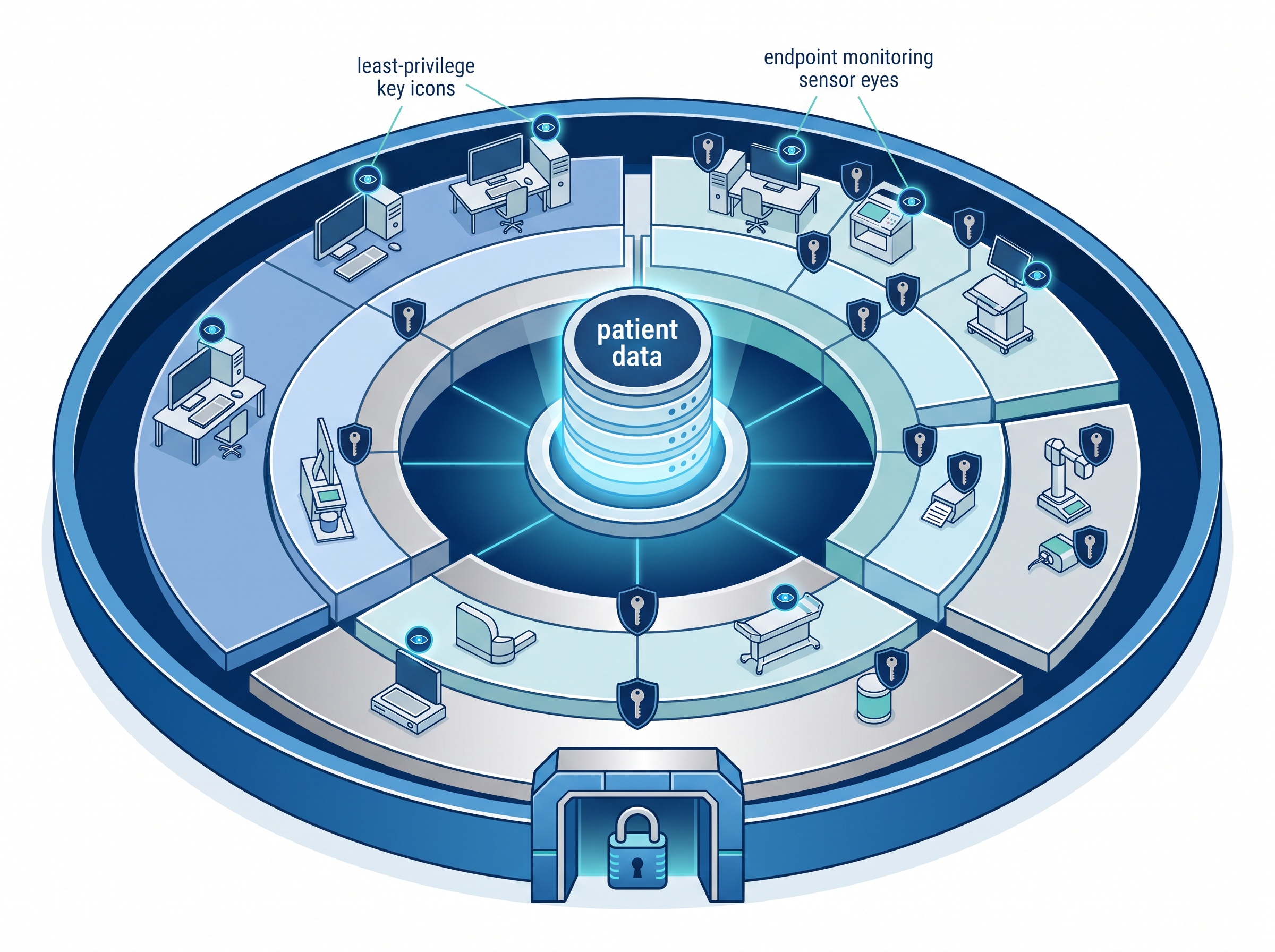
- Least privilege. Privilege-escalation exploits are only valuable if there is a low-privilege foothold to escalate from, and only dangerous if ordinary accounts are one step from full control. Staff should work from standard user accounts, not administrator ones, so a compromised login is a contained problem rather than a master key.
- Deny the initial foothold. Nearly every one of these attacks still needs a way in first — most often a phished credential or a staff member’s click. Awareness training and strong authentication remain the cheapest way to make sure the clever exploit never gets the foothold it requires.
Detection and segmentation: for the flaw you did not patch in time
No practice patches perfectly, and some flaws are exploited before a fix even exists. That is why speed has to be paired with containment and visibility. Network segmentation — keeping imaging devices, clinical workstations, office IoT, and guest Wi-Fi on separate zones — means an attacker who escalates privileges on one machine cannot simply roam to the server holding your patient records. It is one of the concrete reasons we steer practices toward business-grade network security rather than a consumer router.
Alongside it, endpoint detection and response watches each machine for the behaviour an exploit produces — an ordinary account suddenly acting with elevated rights, a process probing the system, credentials being harvested — and flags it as it happens, rather than waiting for damage. Faster exploitation makes fast detection the backstop that buys back the time the shrinking patch window took away.

What this means for your practice
The headline here is not one Linux bug; it is a shift in the tempo of the whole threat landscape. The tools attackers use to turn vulnerabilities into working weapons are getting faster, which means the margin between “a flaw was announced” and “a flaw is being used” is closing. Defence does not require matching that with exotic technology — it requires doing the unglamorous fundamentals faster and more consistently: patch on a short clock, keep everyday accounts out of administrator roles, segment the network, and watch the endpoints so a slipped patch is caught, not catastrophic.
How Compudent Systems can help
At Compudent Systems, we help dental practices across the GTA and Ontario stay ahead of this curve — running managed, monitored patching so critical updates are applied in days rather than forgotten for months, locking down account privileges, segmenting imaging and clinical systems, and deploying endpoint detection so an exploit that slips through is spotted early. Contact Compudent Systems for a security assessment, and let us make sure your practice’s patch window is measured in days, not left wide open for whatever the attackers build next.
Sources & further reading:
Related Reading
- Critical Langflow AI Vulnerability Exploited Within 20 Hours: Urgent Security Alert for Dental Practices
- 974 Patches, Two Being Exploited Right Now: How a Dental Practice Should Read September’s Patch Tuesday
- A Fake Job Offer, a Windows Kernel Rootkit: The Lazarus Zero-Day (CVE-2026-68820) and What It Means for Your Dental Practice