
November 22, 2026 Eleven Minutes to Root: AI Agents Found a Zero-Day in Medical-Imaging Software — What It Means for Your Dental Practice
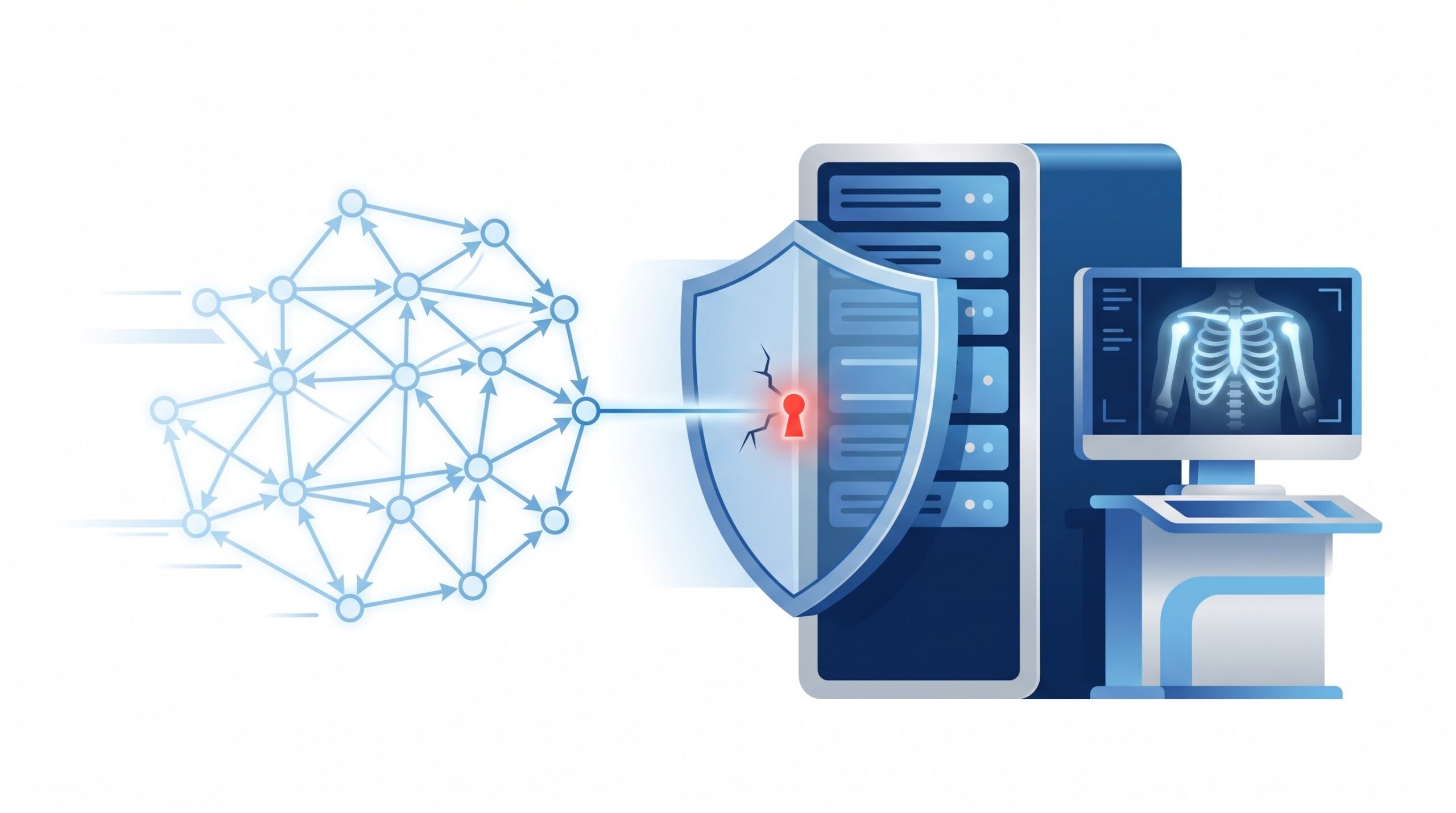
Here is the sentence that should make every dental practice owner put down their coffee: in roughly eleven minutes, a piece of software went from mapping an application’s interface to writing files onto the server behind it — and no human chose the next step. The attacker was not a person hunched over a keyboard. It was a cluster of autonomous AI agents, and the thing they broke into was medical-imaging software.
Amazon’s threat intelligence team disclosed the case this week. For a profession whose entire clinical record now lives inside imaging software, it is not an abstract “AI is scary” story. It is a very specific warning about the kind of system sitting in your server closet right now.
What actually happened
In September, Amazon analysts stumbled on an exposed, password-free instance of Cairn — an open-source AI penetration-testing framework — which let them read the operator’s prompts and watch the agents work. What they saw was a roughly 48-hour campaign, attributed with moderate confidence to a China-linked actor, aimed at universities in East Asia.
The operator handed the agents a list of targets and a goal: get shell access. The agents identified the software running on one target, mapped its programming interface, and discovered a path-traversal bug in a file-upload function. About eleven minutes later they were writing arbitrary files to the server. In a later session they used that foothold to plant a Python reverse shell in a startup file the interpreter loads every time it runs — and walked away with a root shell. Amazon assessed with high confidence that this was a genuine zero-day: no advisory, no issue, no prior mention anywhere.
The software was MONAI Label, an open-source server for AI-assisted annotation of medical images. Its developers have since published a critical advisory confirming the flaw affects versions 0.8.5 and earlier, that authentication is off by default, and that anyone able to reach the server over the network can exploit it. A fix is coming in the next release.
Why “medical-imaging software” should stop a dental office cold

It is tempting to file this under “university research problem.” Resist that. The common thread is not the specific product — it is the category. A dental practice is, from a security standpoint, a small medical-imaging shop. Your intraoral sensors, your panoramic and CBCT units, and your practice-management suite all feed software that runs on a server or a workstation with a network address. That software opens ports, accepts uploads, and exposes an interface so your other machines can talk to it.
That is precisely the shape of thing the agents went after. It does not matter that your imaging vendor is a commercial product rather than an open-source project; what matters is whether it is reachable, whether it ships with weak defaults, and whether it is kept current. We have watched this play out before in imaging specifically — recall the FDA recall of a PACS over a hijackable admin session. The imaging layer is not a backwater. It is where the sensitive data lives, and attackers know it.
The genuinely new part is speed, not intelligence
We have written before about how the attacker is becoming an AI agent. This incident is the concrete proof. The individual techniques here — path traversal, a planted reverse shell — are decades old and well understood. What changed is who runs them and how fast.
A human attacker has to choose targets, get bored, sleep, and move on. An agent does not. It can be pointed at a range of addresses and told to find anything reachable, then grind through every service it sees without fatigue, at machine speed. The eleven-minute figure is the headline because it collapses the window a defender used to rely on. There is no longer a comfortable gap between “someone is poking at us” and “someone is inside.” If your imaging server is exposed and out of date, the time-to-compromise is now measured in minutes.
The weak default that made it all possible

Notice the two ingredients. First, authentication was off by default — so merely reaching the server over the network was enough. Second, a file-upload feature did not properly constrain where files could be written. Neither is exotic. Both are exactly the kind of setting that gets left at its default during a busy installation, because it “just works” and nobody circles back.
In a dental office the equivalents are everywhere: an imaging service installed with a blank or default admin password, a backup appliance or NAS left reachable, a remote-access tool opened to the internet “temporarily.” Those are the doors an agent walks through. The same lesson drove the recent warning to patch network appliances fast after CISA flagged an actively exploited NAS flaw — the quiet boxes are on the list.
What your practice should do this week

You do not need a security operations centre. You need to make your imaging systems genuinely hard to reach and current. In priority order:
- Inventory your imaging software and versions. You cannot protect what you have not listed. Write down every piece of imaging and practice-management software, what server or PC it runs on, and what version it is.
- Make sure authentication is on — everywhere. No imaging server, admin console, or database should be reachable without a real password. Replace every default or blank credential today.
- Never expose imaging systems to the internet. If a vendor or staff member needs remote access, it goes through a properly configured VPN, not a port opened straight to the imaging server.
- Segment the network. Clinical and imaging devices belong on their own isolated segment, away from front-desk PCs and well away from guest Wi-Fi. Segmentation is what turns a reachable flaw into an unreachable one.
- Patch promptly, especially the quiet appliances. Imaging software, servers, NAS units and firewalls all need a real update routine — not “whenever we remember.”
- Turn on logging. If something does probe your network, you want a record of it rather than silence.
If that list feels like a lot, start with a proper security risk analysis — it is the structured way to find which of these gaps you actually have, and it is a compliance obligation besides.
The takeaway

The MONAI Label case is not a reason to panic about artificial intelligence. It is a reason to treat the imaging systems in your practice as the critical infrastructure they are. The attackers got in through unglamorous, fixable mistakes — defaults left on, software left reachable, updates left undone — and the AI simply found and used them faster than any human could. Close those doors and the speed of the attacker stops mattering, because there is nothing left to reach.
If you are not sure whether your imaging server, backups, or remote access are exposed, that uncertainty is the problem worth solving first. Compudent Systems works with dental practices across the GTA and Ontario to inventory, segment, and harden exactly these systems. Contact us for a practical assessment — before an agent you never see does the inventory for you.
Sources & further reading:
Related Reading
- AI Just Moved Into the Scanner: What Chairside Detection Like Medit AuraVue and Overjet Means for Your Practice IT
- How Dental AI Tools Connect to Your Imaging Software: TWAIN, DICOM, API, and PMS Bridges
- Half Your Connected Devices Carry a Critical Flaw. Can Agentic AI Finally Clear the Patching Backlog?