




March 30, 2026 CISA Issues Critical Alert: Aqua Security Trivy Vulnerability Poses Serious Supply Chain Risk to Dental Practices
The Cybersecurity and Infrastructure Security Agency (CISA) has added a critical vulnerability in Aqua Security’s Trivy scanner to its Known Exploited Vulnerabilities (KEV) catalog, marking it as a high-priority threat actively being exploited in the wild. For dental practices relying on modern IT infrastructure, this development highlights the growing risks associated with supply chain vulnerabilities in security tools.
Understanding CVE-2026-33634: The Trivy Supply Chain Threat
The vulnerability, tracked as CVE-2026-33634, affects Trivy—a popular open-source vulnerability scanner used to detect security issues in container images, file systems, and repositories. What makes this particularly concerning for dental practices is that Trivy is deeply integrated into many organizations’ CI/CD (Continuous Integration/Continuous Deployment) pipelines and development environments.
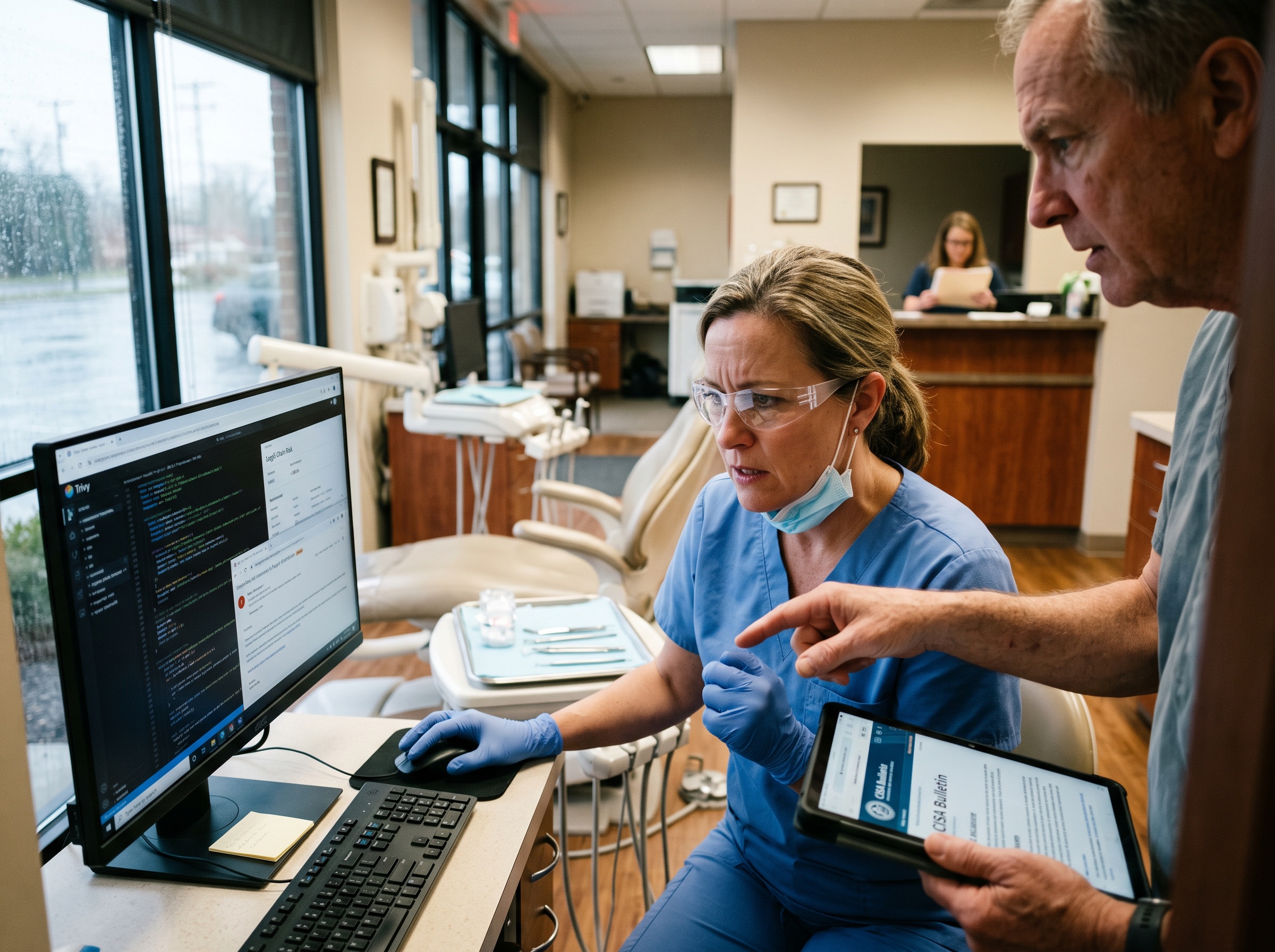

At its core, CVE-2026-33634 involves embedded malicious code that can be triggered by threat actors to execute unauthorized actions. This type of vulnerability is classified under CWE-506 and represents a particularly insidious form of attack because it exploits trust in legitimate security tools.
The Attack Vector: How Threat Actors Exploit CVE-2026-33634
When successfully exploited, this vulnerability allows attackers to bypass standard access controls and gain deep visibility into IT environments. The malicious code enables attackers to:
- Scan memory spaces for sensitive operational data
- Extract development tokens and authentication credentials
- Access SSH keys and cloud infrastructure passwords
- Retrieve backend database credentials
- Manipulate software builds and inject malicious code
Given Trivy’s elevated privileges during scanning processes, a successful exploit effectively grants attackers access to critical components of the software development lifecycle—making this vulnerability particularly attractive to Advanced Persistent Threat (APT) groups.
Implications for Dental Practice IT Security
While dental practices may not directly use Trivy in their day-to-day operations, the vulnerability has broader implications for healthcare IT security. Many dental software vendors and IT service providers use development tools like Trivy in their software creation and deployment processes. A compromise in these upstream systems could potentially:

- Inject malicious code into practice management software updates
- Compromise patient data through tainted software deployments
- Create backdoors in dental imaging systems
- Affect the integrity of HIPAA compliance monitoring tools
CISA’s Response and Timeline
CISA officially added CVE-2026-33634 to its KEV catalog on March 26, 2026, confirming active exploitation in real-world scenarios. The agency has issued a strict remediation deadline of April 9, 2026, for Federal Civilian Executive Branch (FCEB) agencies to address the vulnerability.
This aggressive timeline underscores the severity of the threat and the potential for widespread impact across government and private sector organizations.
Immediate Action Steps for Dental Practices
While dental practices may not directly run Trivy, they should take proactive steps to protect their IT infrastructure:
1. Vendor Communication
Contact all software vendors and IT service providers to confirm they are not using affected versions of Trivy in their development or deployment processes. Request written confirmation of their security posture.
2. Supply Chain Assessment
Review your technology supply chain to identify any vendors who might be affected. This includes practice management software providers, imaging solution vendors, and cloud service providers.
3. Enhanced Monitoring
Implement additional network monitoring to detect unusual activities that might indicate a supply chain compromise has reached your environment.
4. Update Security Policies
Ensure your vendor security requirements include provisions for disclosure of supply chain vulnerabilities and mandatory security updates.
The Broader Supply Chain Security Challenge
The Trivy vulnerability represents a growing trend in cybersecurity where trusted security tools themselves become attack vectors. For dental practices, this highlights the importance of:
- Maintaining strong vendor relationships with clear security communication channels
- Implementing defense-in-depth strategies that don’t rely solely on vendor security
- Regular security assessments that include supply chain risk evaluation
- Incident response plans that account for supply chain compromises
Moving Forward: Strengthening Dental Practice Cybersecurity
As the healthcare sector faces increasing cyber threats, dental practices must adopt a proactive approach to cybersecurity that extends beyond their immediate IT infrastructure. The CVE-2026-33634 incident serves as a reminder that modern cyber threats often originate from unexpected sources—including the very tools designed to protect us.
By maintaining strong vendor relationships, implementing comprehensive security monitoring, and staying informed about emerging threats, dental practices can better protect their operations and patient data from sophisticated supply chain attacks.
For dental practices using Compudent Systems IT solutions, our team continuously monitors supply chain security developments and proactively addresses potential vulnerabilities in our client environments. Contact us for a comprehensive security assessment to ensure your practice is protected against both direct and supply chain cyber threats.
Related Reading
- CISA Issues Critical Infrastructure Alert: Seven New ICS Vulnerabilities Threaten Connected Dental Systems
- Critical Docker CVE-2026-34040 Authorization Bypass Vulnerability: Immediate Security Alert for Dental Practices
- Critical Weaver E-cology CVE-2026-22679 Vulnerability: Urgent Security Alert for Dental Practices Using Enterprise Collaboration Platforms