




February 12, 2026 AI-Powered Phishing and Deepfake Scams: The New Threats Targeting Dental Practices in 2026
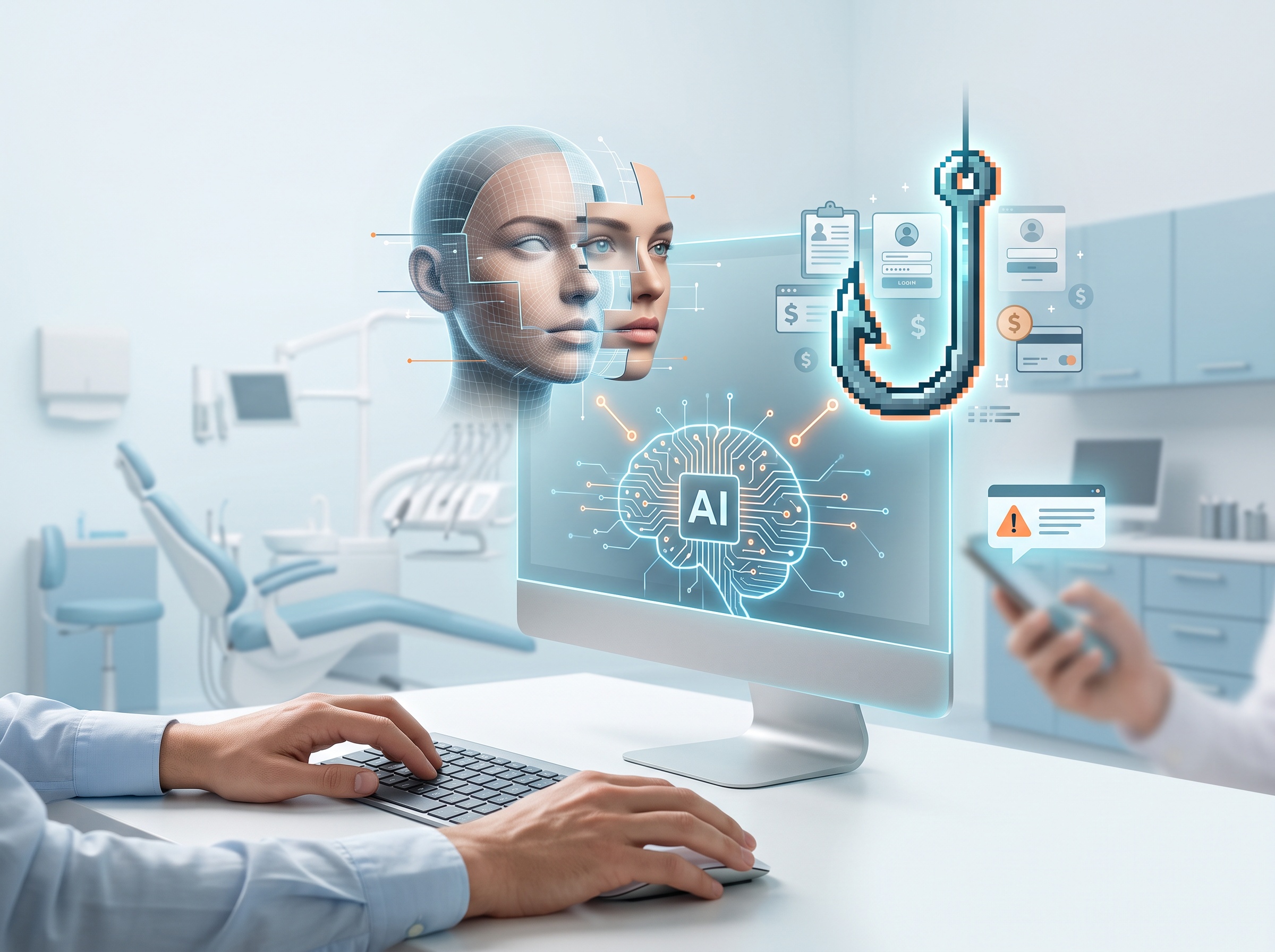
Phishing emails used to be easy to spot — broken English, suspicious links, and generic greetings were dead giveaways. In 2026, those days are over. Cybercriminals are now weaponizing artificial intelligence to create hyper-personalized phishing campaigns and deepfake scams that are virtually indistinguishable from legitimate communications.
For dental practices, which handle sensitive patient health information and process financial transactions daily, these AI-enhanced attacks represent a serious and growing threat.

How AI Has Transformed Phishing
Traditional phishing relied on casting a wide net with generic messages, hoping someone would click. AI-powered phishing is fundamentally different. Attackers now use large language models to:
- Craft perfectly written emails that match the tone, style, and terminology of legitimate dental industry communications
- Personalize messages at scale using information scraped from LinkedIn, practice websites, and social media
- Generate convincing fake websites that clone your dental supply vendor’s portal or insurance company login page
- Automate conversation — AI chatbots can now engage in real-time email or text exchanges that feel completely natural
According to security researchers, AI-generated phishing emails have a significantly higher click-through rate than traditional phishing because they lack the telltale signs that trained users look for.
Deepfake Voice and Video Scams
The most alarming development in 2026 is the rise of deepfake-powered social engineering. Attackers can now:
- Clone voices from short audio samples: A 30-second clip from a dentist’s voicemail greeting or conference presentation is enough to generate a convincing voice clone. Attackers use this to call office staff and authorize fraudulent wire transfers or request patient records.
- Create realistic video calls: Deepfake technology can now generate real-time video of a person speaking, making it possible for an attacker to impersonate a practice owner or IT vendor during a video conference.
- Build synthetic identities: Combining deepfake photos, AI-generated communications, and stolen personal data, attackers create entirely fictional people who appear completely real across multiple channels.
Real-World Scenarios for Dental Offices
Here’s how these attacks might play out in your practice:

Scenario 1: The Fake Vendor Invoice. Your office manager receives an email from what appears to be your dental supply company, complete with your actual recent order history. The email explains they’ve updated their banking details and asks you to update your payment information. The email is AI-generated, perfectly formatted, and references real orders scraped from a previous data breach.
Scenario 2: The Deepfake Phone Call. Your front desk receives a call that sounds exactly like the practice owner, asking them to process an urgent wire transfer for new equipment. The voice is a deepfake clone generated from the dentist’s YouTube videos or podcast appearances.
Scenario 3: The AI Insurance Scam. A patient receives a convincing email appearing to come from your practice, complete with your logo and branding, asking them to verify insurance information through a fake portal. The email was generated by AI using publicly available information about your practice.
Phishing-as-a-Service: Attacks for Hire
Making matters worse, phishing-as-a-service (PhaaS) platforms now offer turnkey attack campaigns that anyone can purchase. These kits include AI-generated email templates, cloned websites, and even deepfake tools — all available on dark web marketplaces for a few hundred dollars. This dramatically lowers the barrier to entry for cybercriminals targeting dental practices.
How to Protect Your Dental Practice
Traditional security awareness training is no longer sufficient on its own. Here’s what you need in 2026:
Implement Verification Protocols
- Establish a verbal code word for financial transactions that must be confirmed in person or via a known phone number
- Never process payment changes or wire transfers based solely on email or phone requests
- Require two-person authorization for any financial transaction over a set threshold
Upgrade Your Email Security
- Deploy AI-powered email security tools that can detect AI-generated content
- Enable advanced anti-phishing features in Microsoft 365 or Google Workspace
- Configure DMARC, SPF, and DKIM to prevent email spoofing of your domain
Train Staff on Deepfake Awareness
- Educate team members that voice calls and even video calls can be faked
- Establish callback procedures: if you receive an unusual request by phone, hang up and call back using a known number
- Be skeptical of urgency — attackers create time pressure to prevent verification
Limit Your Digital Footprint
- Audit what information about your practice is publicly available online
- Be cautious about posting staff photos, voice recordings, and detailed organizational information
- Consider what a sophisticated attacker could learn from your website and social media
The Human Firewall Still Matters
Despite the sophistication of AI-powered attacks, your team remains your best defense — but only if they’re properly trained and empowered. Create a culture where questioning unusual requests is encouraged, not punished. A front desk employee who delays a wire transfer to verify its legitimacy isn’t being difficult — they’re protecting the practice.
The phishing landscape has fundamentally changed. The question isn’t whether your dental practice will be targeted by AI-powered attacks — it’s whether your team will be prepared when it happens.